Singapore As A Maritime Gateway After Independence
Following independence in 1965, Singapore faced the daunting challenge of survival in a rapidly changing global economy. No longer just a regional entrepot under the British, the young nation had to reinvent its maritime identity and become an export-oriented economy. By embracing containerisation, investing in cutting-edge infrastructure, and leveraging its strategic geography, Singapore transformed into one of the world’s busiest and most efficient transshipment hubs. This era is defined by a shift from labor-intensive manual cargo handling to a high-tech, automated maritime ecosystem that serves as the lifeblood of the nation’s economy.
Becoming a Global Maritime Gateway
Singapore’s maritime industry has long been the backbone of its economic growth, evolving from an early regional trading post into a world-class port system. As trade flourished over the decades, the need for larger and more efficient facilities necessitated a gradual shift of maritime operations from the constrained Singapore River to the deep-water coastal areas of Tanjong Pagar and Keppel Bay. Before the era of containerization, port operations were heavily labor-intensive, relying on the manual loading and unloading of cargo—a process that was both slow and physically taxing. The strategic shift toward specialized deep-water berths laid the foundation for Singapore’s emergence as a global maritime hub, transforming the nation into one of the world’s busiest and most technologically advanced container ports today.
The Maritime Gateways of Singapore
Singapore’s geography at the intersection of major global shipping routes has led to the development of diverse maritime gateways, each serving a specific role in the nation’s economy. These gateways are not limited to cargo alone; they encompass a sophisticated network of terminals designed for industrial raw materials, energy products, and international passenger travel. From the historic container berths near the city center to specialized industrial piers and modern cruise hubs, these facilities act as the critical entry and exit points that connect Singapore to the global supply chain and the regional archipelago. As the maritime industry evolves, these gateways continue to adapt through technological integration and physical expansion to maintain Singapore’s status as a premier global hub.
Types of Shipping Vessels
The story of Singapore’s maritime development is reflected in the diverse array of vessels that have graced its waters for over two centuries. From the wind-driven sailing ships of the 19th century to the large-scale steel hulls of today, each vessel represents a specific stage in the nation’s economic history. In the early days of the entrepot trade, the waterways of Singapore were a forest of traditional wooden crafts such as Junks and Tongkangs which relied on the monsoon winds and manual labour to move goods across the region. The arrival of steam power followed by giant container ships and supertankers transformed Singapore’s ports into global infrastructure hubs. Today, Singapore’s waters is home to some of the world’s largest and most technologically advanced ships. These vessels are central to the global supply chain and Singapore’s position as the best port in the world. Below is a gallery of some of these shipping vessels.
Guiding the Global Fleet: The Heritage Legacy of Singapore’s Lighthouses
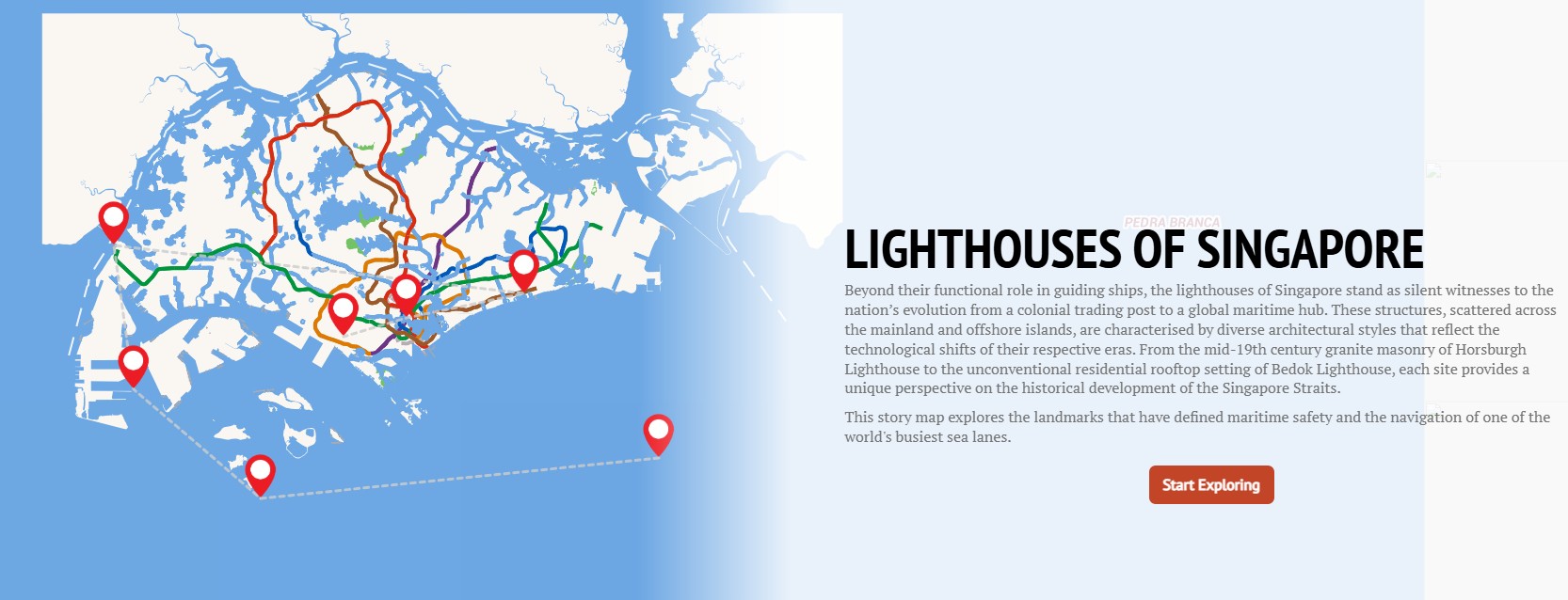
The continual growth of Singapore’s maritime sector during the post-independence era was built upon a foundation of safety and reliability. But unbeknownst to many, a quiet contributor to this mission is the collection of lighthouses scattered across the Singapore Strait and its offshore islands. These landmarks serve as a bridge between the colonial past and the technological present, standing as physical reminders of Singapore’s enduring maritime heritage stretching back to the colonial period. By mapping these vital navigational beacons on a map, we see a story map of a nation taking full command of its waters and ensuring that, despite the rapid pace of modernisation, the legacy of safe seafaring remains a constant.