
Becoming Bras Basah.Bugis
Discover how Bras Basah and Bugis were transformed from rundown inner-city districts into a vibrant cultural precinct, blending heritage conservation with modern renewal.
Last updated on 25 August 2026
In Need For Renewal
Until the 1970s, Bras Basah and its adjacent district, Bugis, were abuzz with activities, thanks to the schools, bookstores, cinemas, hawkers and nightlife there. But like other inner-city areas, the two districts were in need of renewal as its streets were congested and colonial-era shophouses in dilapidated condition. To address these issues, the Urban Redevelopment Authority (URA) extended its urban renewal programme to Bras Basah and Bugis. This saw many buildings in the area being torn down and redeveloped.
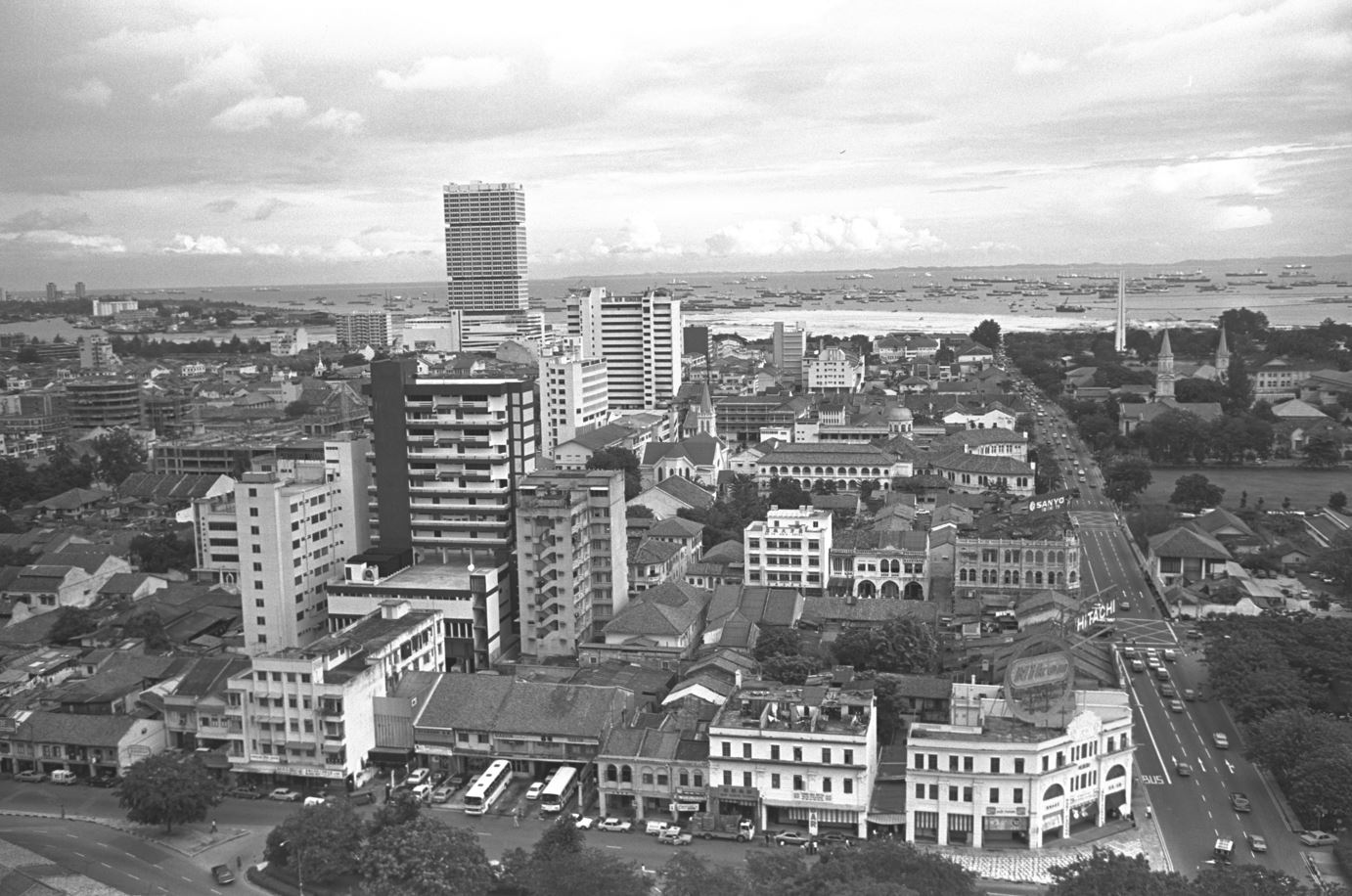
Bras Basah and its neighbouring district, Bugis, were among the busiest parts of the city centre. However, the area was in need of renewal as its streets were congested and colonial-era shophouses in dilapidated condition. (Image Credit: Ministry of Information and the Arts Collection, courtesy of National Archives of Singapore (opens in new tab))
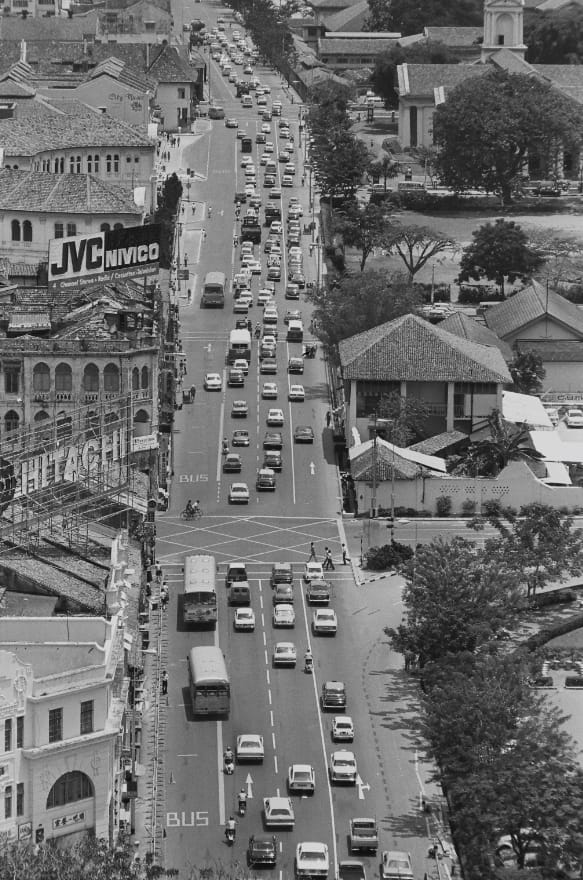
A 1974 photograph of a traffic jam along Bras Basah Road. (Image Credit: The Straits Times © Singapore Press Holdings Limited. Reprinted with permission (opens in new tab))
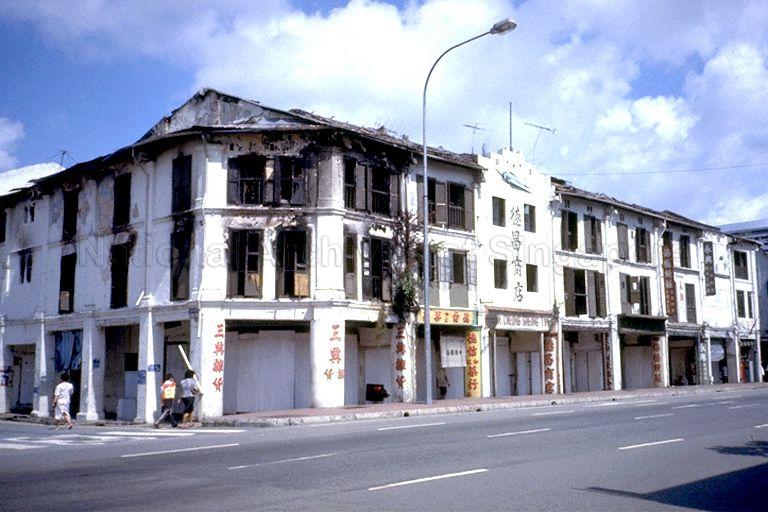
A photograph of dilapidated shophouses in Bras Basah taken in the 1980s. (Image Credit: Singapore Tourist Promotion Board Collection, courtesy of National Archives of Singapore (opens in new tab))
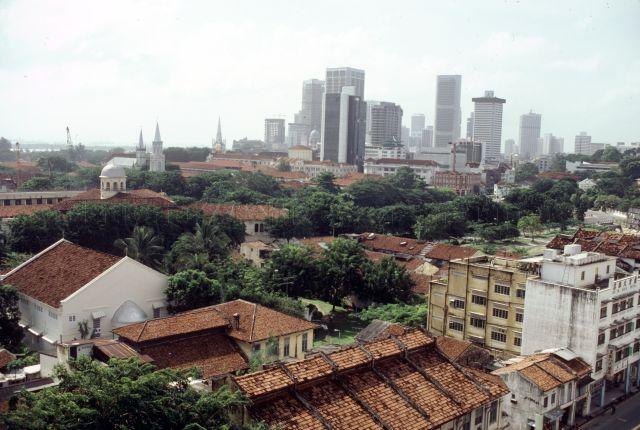
An early 1980s aerial view of Bras Basah with the dome of the former St Joseph’s Institution and steeples of the chapel of the former Convent of the Holy Infant Jesus, Cathedral of the Good Shepherd and St Andrew’s Cathedral are visible in the background. (Image Credit: G P Reichelt Collection, courtesy of National Archives of Singapore (opens in new tab))
Revitalisation of Bras Basah and Bugis
By the early 1990s, the Bras Basah and Bugis districts had developed a new shine but they were quieter and less vibrant than before. To rejuvenate the area, the URA decided to develop them together as a heritage, arts and learning enclave. Guided by the Rochor Development Guide Plan (DGP), which was released in 1993, buildings in the area ranging from former school grounds to cinemas and shophouses were turned into commercial developments as well as cultural and heritage spaces.
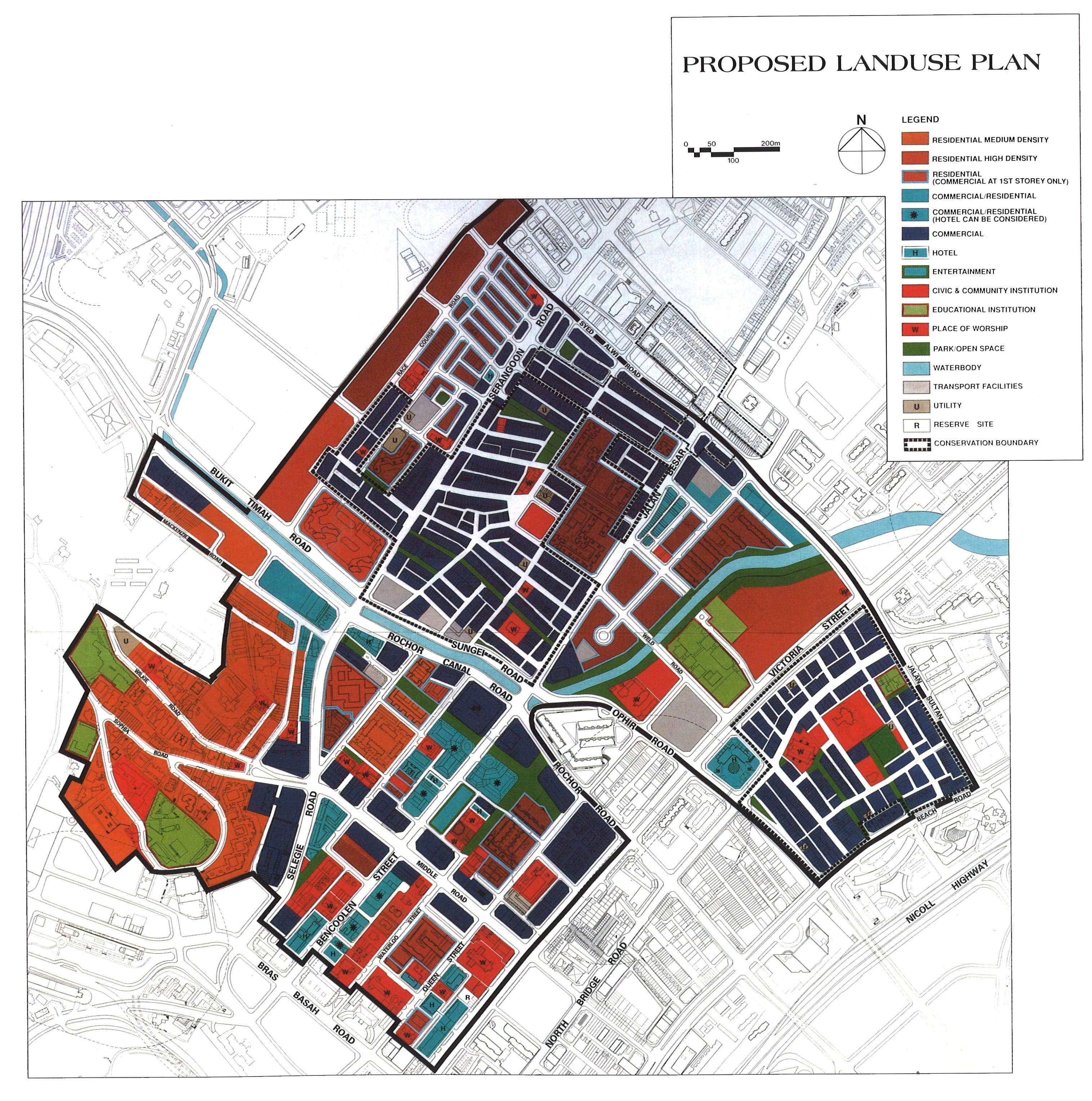
Recognising both Bras Basah and Bugis possessed many eclectic elements that contributed to Singapore’s unique and distinctively Asian identity, the Rochor DGP aims to add new vitality to the two districts by harnessing and enhancing its historical and cultural heritage. (Image Source: Rochor: Draft Development Guide Plan (opens in new tab))
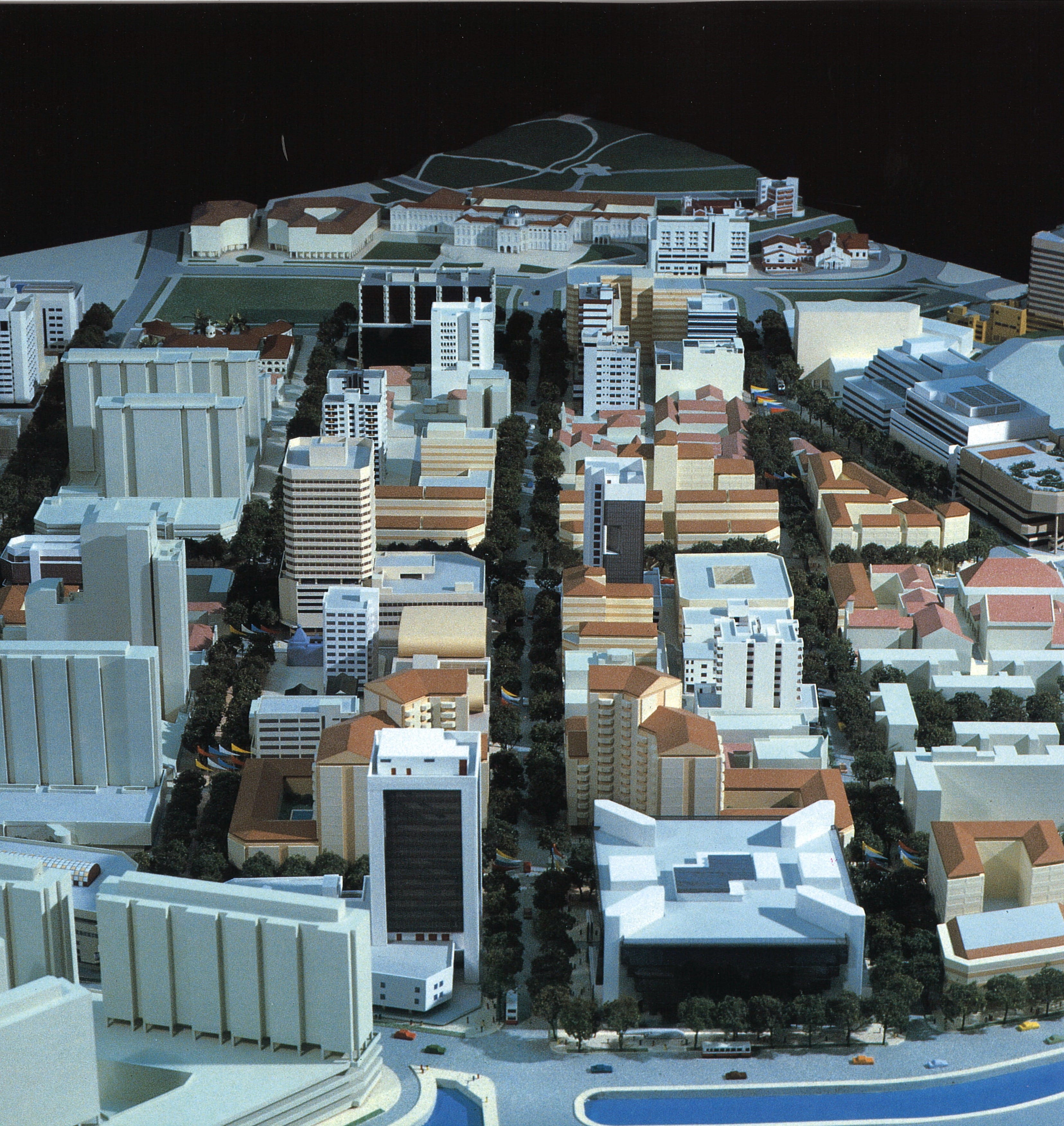
URA’s strategy to revitalise Bras Basah and Bugis involved the introduction of new commercial developments such as office buildings and shopping complexes as well as the conservation of historically significant buildings. This coexistence of old and new can be seen in the above model representation of the Rochor DGP, (Image Source: Rochor: Draft Development Guide Plan (opens in new tab))
Becoming Bras Basah.Bugis
The revitalisation of Bras Basah and Bugis following the launch of the Rochor DGP has allowed the two districts to become the Bras Basah.Bugis (BBB) precinct of today. First announced after the release of the 2003 Master Plan, BBB is identified by the URA as a “treasure trove of cultural and architectural references” marked by its compelling blend of old and new architecture.
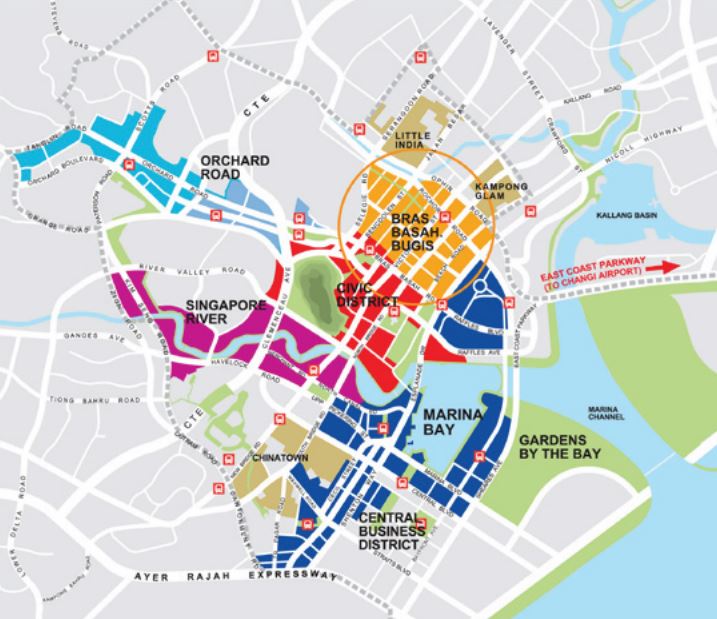
The Bras Basah.Bugis precinct, as shown in the map above, is bounded by Rochor Road, Beach Road, Selegie Road and Bras Basah Road. (Image Source: Celebrating The City: Bras Basah.Bugis (opens in new tab))
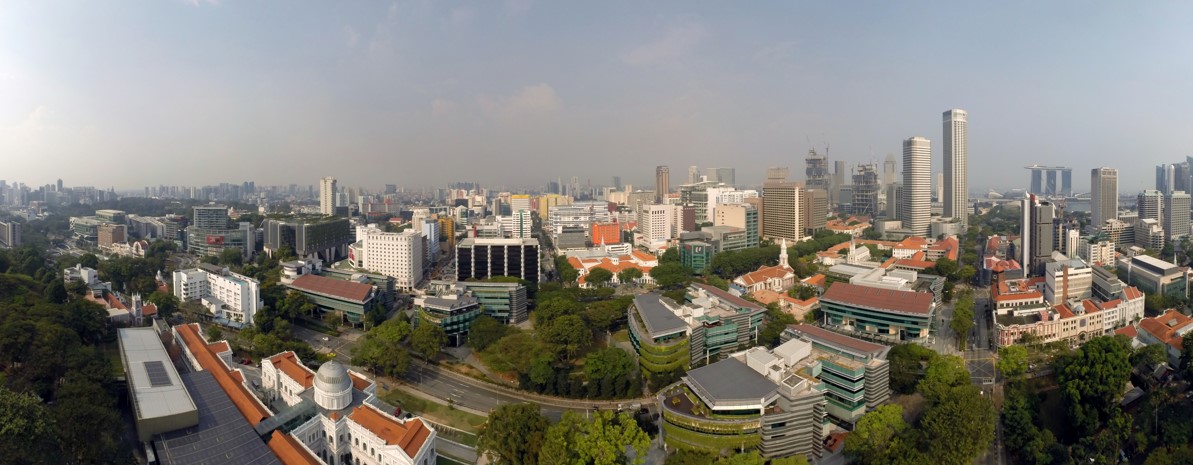
A panoramic shot of the Bras Basah.Bugis precinct today from Fort Cannning Hill looking towards Bugis. (Image Source: Photo by Chensiyuan via Wikicommons (opens in new tab))
The ability of BBB to retains its architectural and cultural heritage has made itself unique compared to other precincts especially Orchard Road and the Downtown Core. This identity is further enhanced by the existence of renowned educational institutions and arts groups in BBB as it did in the past.
To capture the the arts and heritage identity of BBB, you can embark on these heritage trails below.
Expand this for links to the heritage trials above
An Ode To Bras Basah
Emeritus Professor and Professorial Fellow of the National University of Singapore Edwin Thumboo has been involved in Singapore’s literary developments since the 1950s. Over the course of his illustrious career, where he received many awards including the Singapore Cultural Medallion and Singapore’s Meritorious Service Medal, he has published five volumes of poetry. While many of his poems address national issues, some are dedicated to places in Singapore. One of these is “Bras Basah”. It is a remarkable place poem as Thumboo was able to vividly capture the Bras Basah of old in just a few verses.
Where the first Rendezvous brooded By a row of old shophouses, since sadly slain, A special road began. A point of colonial Confluence: Dhoby Ghaut, the YWCA with Manicured tennis lawns for memsahibs who Then took tea and scones. Across a Shell kiosk Where Papa parked his Austin Seven, then off To Hock Hoe’s for piston rods and Radex Think of the names: Dhoby Ghaut, Prinsep St, The three Cathays, a name the Lokes made Famous: resplendent building, our tallest then; Fantastic camera shop; and that popular Store Where Rudy’s wife, petite, temporarily demure, Quietly assessed her customers as she held her Intelligence above show-cases. Two doors away, Heng, increasingly called Mr, sold German cameras To Japanese sailors, was en route to a partnership. And the bookshops full of stuff: Penguin New Writing to Palgrave’s G-Treasury; Q’s Oxford Anthology, a blue spine among mouldy issues Of The Wide World where imperial dreams, The White man’s burden trudged across Asia and Africa, up Ruwenzori’s mist and moon, then down The Brahmaputra. Mainly first-hand accounts, Direct, unshorn, marching against superstition. Plain narratives rising in majesty, in power, art. No cute theory of the Other. Only them natives. And the Rendezvous after school; affordable. The man with the mole, ladle in hand, presided, Holding the extra spoonful, balanced fate,deciding If he liked you. Two doors away Simon Ong’s Family shop of fishing tackle, Winchester torches, Knives of Solingen steel. Outside, a Woodsville tram, Full of St Andrew boys, swings around the corner, Tires squealing. Standing there, the world grew, Bit by bit, seemed different with each fresh vantage Shift in weather; hormonal stir, sweet unknowing; An ache that knew no words; a quickly passing mouth. As eyes caught more lit with sensuous guilt, when Curves beneath Convent uniforms heaved and turned With the mind’s proposal, the rainbow’s ripening, As thoughts fingered image, each chance encounter. Experience became a word as Life cease to be simple.— Edwin Thumboo's "Bras Basah" poem (1953)
Bras Basah Resource Map
Geo-tagged on the map below are some of the key resources that were used in this showcase. Click on the map below to experience this. The resources have been categorised by format using different coloured location pins.
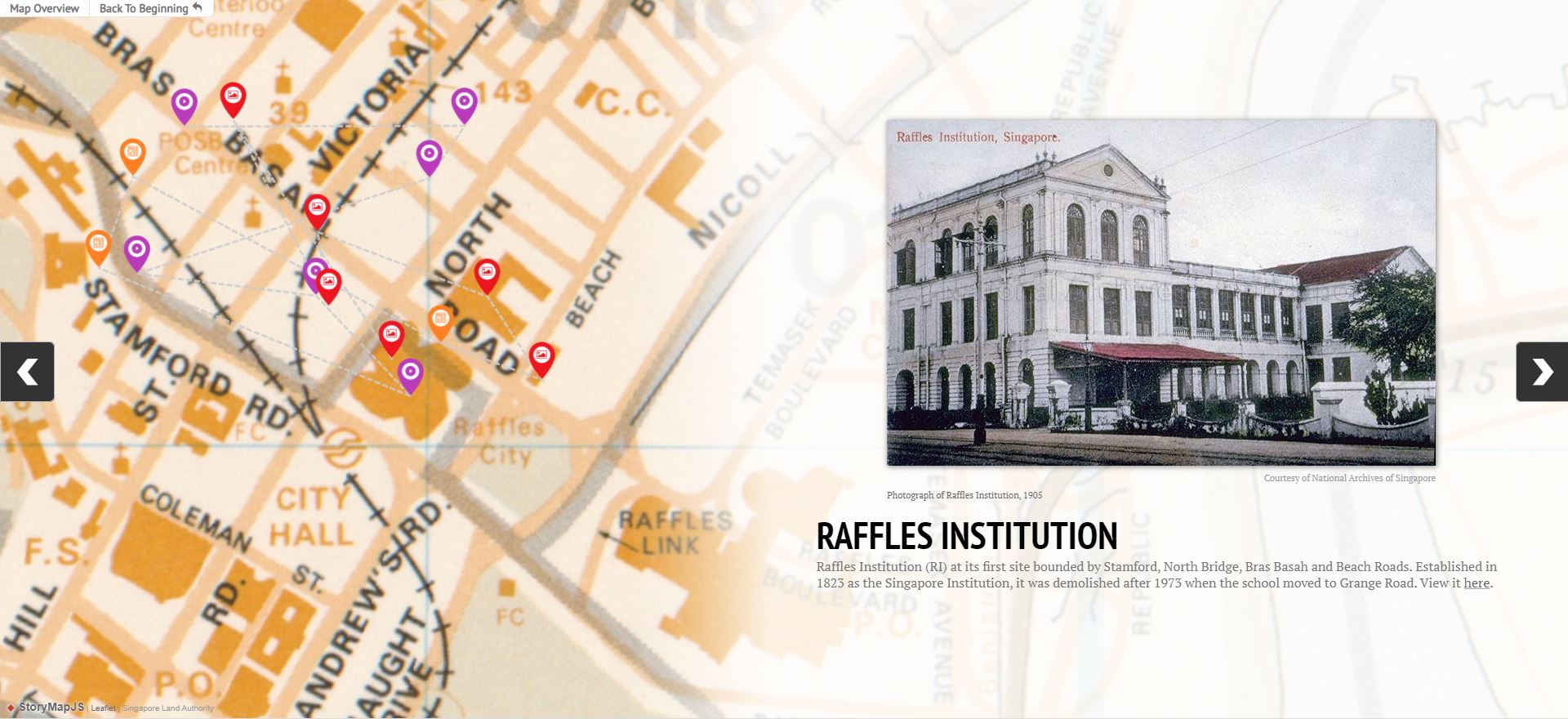
Click HERE (opens in new tab) to view the resource map