
Gardens, Cemeteries and Waterbodies
Discover the rich history of Fort Canning Hill's gardens, cemeteries, and leisure spaces, from Singapore's first botanic garden to its early swimming pools.
Last updated 25 August 2026
Besides once being a base from which the British projected its military power, Fort Canning Hill was also used for recreational activities. For the past 200 years, the hill was home to not only parks and gardens, but also to an aquarium, swimming pools and a theatre.
The First Botanic Garden
The Singapore Botanic Gardens (opens in new tab) at Cluny Road today is not the first botanic garden in Singapore. Before its founding in 1859, the British had explored the idea of a botanic garden when they established a “Botanical and Experimental Garden” on the slopes of Fort Canning Hill.
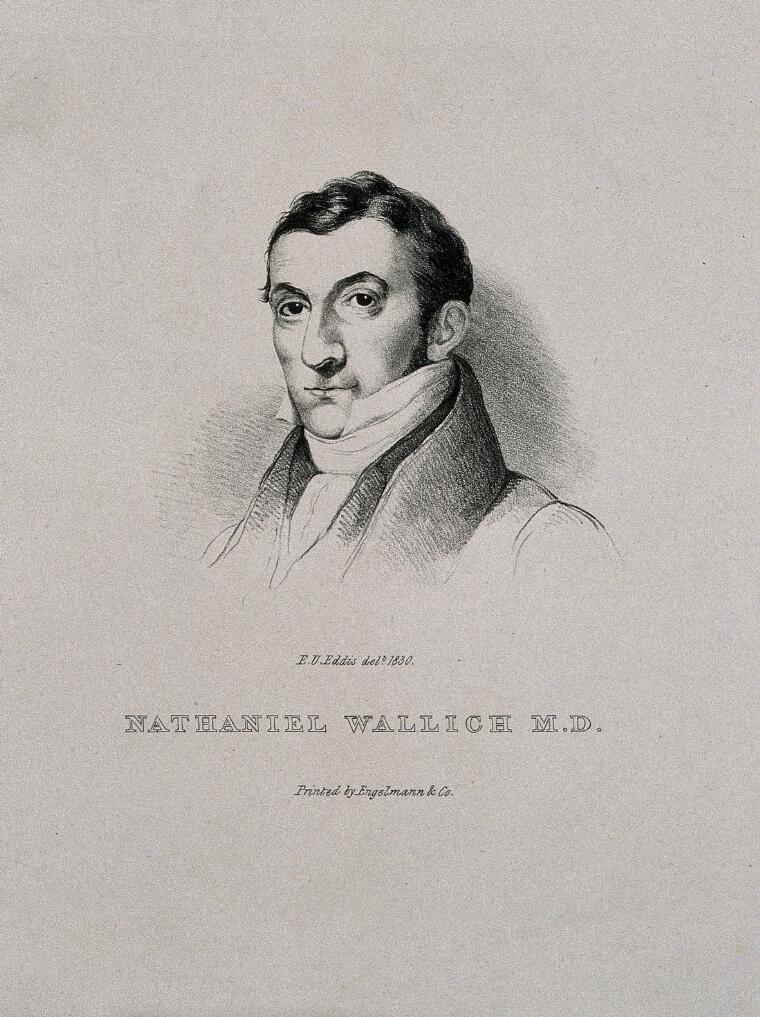
The British had a tradition of setting up gardens in the colonies of their empire to experiment with the cultivation of cash crops and research native plants, and Singapore was no exception. In fact, when Nathaniel Wallich (shown here) proposed the idea to Sir Stamford Raffles, he was serving as the superintendent of the Calcutta Botanic Garden (shown above), which had been established in 1787. (Image Credit: Nathaniel Wallich. Lithograph by E. U. Eddis, 1830. Wellcome Collection (opens in new tab))
"I request your indulgent attention while I take the liberty of submitting for your consideration some ideas, which have occurred to me relative to the expediency of establishing a Botanic and Experimental Garden on this Island. It would perhaps be impossible to picture to the mind a situation better calculated in every respect to accomplish the ends of such an institution than that, which Singapore represents in reality, placed under circumstances the most favourable for indigenous as well as foreign vegetation and forming part of the richest archipelago in the world - its soil yielding none in fertility, its climate not exceeded by any in uniformity, mildness and salubrity. It abounds in an endless variety of plants equally interesting to the botanist, the agriculturist and the gardener, with unrivalled facilities and opportunities of disseminating these treasures and exchanging them for others...I beg leave to recommend that a suitable piece of ground may be appropriated in the neighbourhood of the European town for the purposes of a botanic garden and for the experimental cultivation of the indigenous plants of Singapore and the adjacent Islands, as well as of such others of foreign growth, as it might be desirable to submit to a skillful trial, previous to encouraging their general introduction. The expenses of such a garden would, I imagine, be moderate; that they would in the event be infinitely compensated by the beneficial results, which the public at large would derive from its influence."— The excerpt above taken from a 2 November 1822 letter reproduced in the Journal of the Straits Branch of the Royal Asiatic Society (December 1913, Call no.: RCLOS 959.5 JMBRAS), Danish surgeon and naturalist Nathaniel Wallich outlines the ideal climate and suitability of Singapore for establishing its first botanic garden to Sir Stamford Raffles:
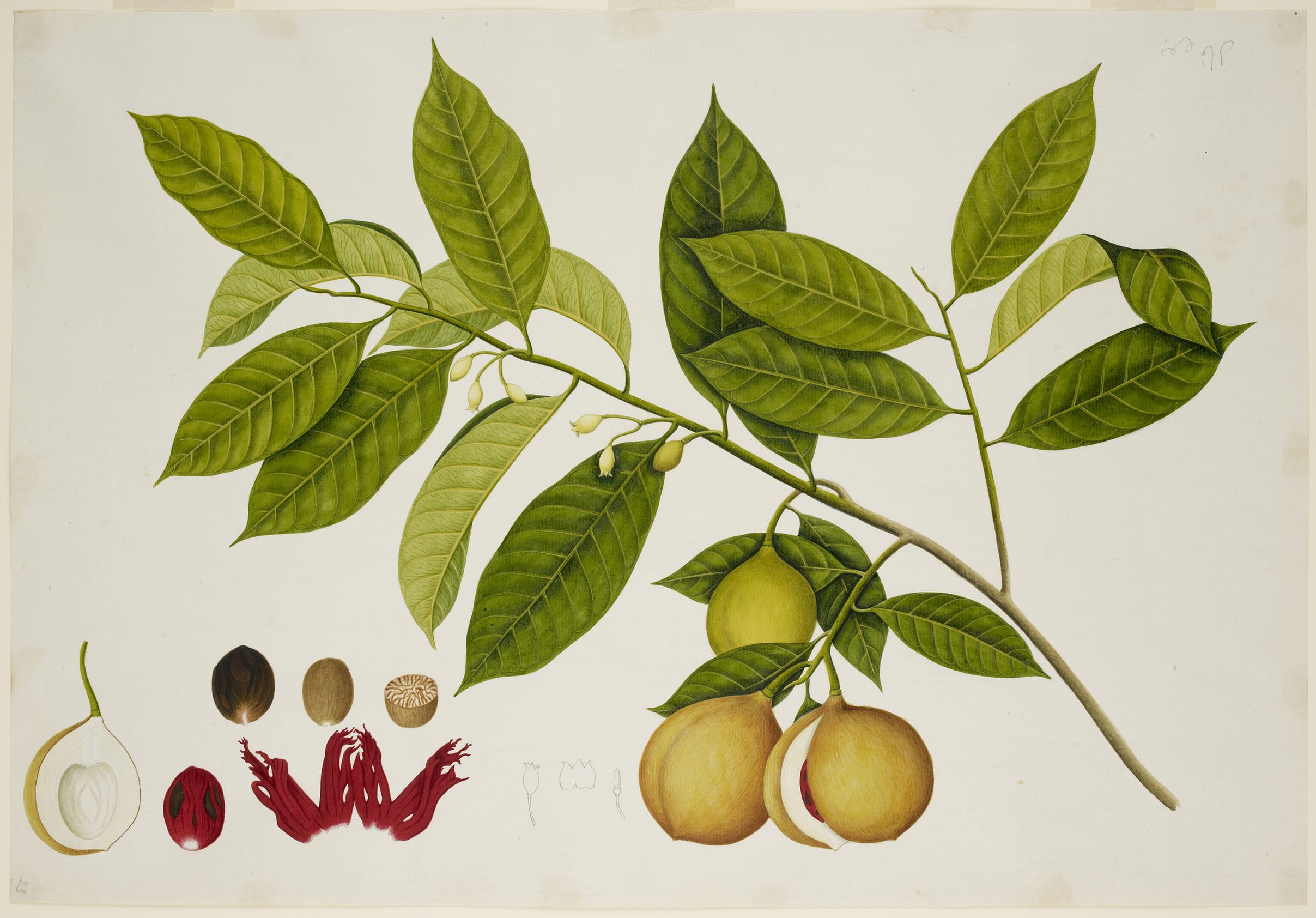
Raffles had been considering the idea of establishing a botanic garden in Singapore since his arrival in 1819. In fact, by the time Wallich submitted his proposal in 1822, an experimental “spice garden” had already been established on Fort Canning Hill. Referred to as the “Government Garden” by Raffles, it was created by Singapore’s first Resident and Commandant, Major-General William Farquhar. The garden contained at least 125 nutmeg trees and other crops, including clove trees. This 1824 drawing shows the nutmeg seed and leaves. (Image Credit: The British Library via Wikicommons (opens in new tab))
"I have to acknowledge the receipt of your letter…submitting for my consideration the advantage of establishing a Botanic and experimental Garden at this Settlement. Situated as Singapore is, in the very heart of the Malayan Archipelago and midway between India China and New Holland it is hardly possible to conceive a position more admirably calculated for such an establishment as your active zeal in the cause of Science has prompted you to suggest…The advantages are obvious and I rejoice that I am enabled to avail myself of your superior genius and experience in laying down a Plan for its' commence."— In a letter dated 15 November 1822, reproduced in a 1981 issue of the Journal of the Malaysian Branch of the Royal Asiatic Society (Call no.: RCLOS 959.5 JMBRAS, p. 13), the above excerpt reveals Sir Stamford Raffles’s enthusiastic support for Nathaniel Wallich’s proposal to establish a botanic garden, agreeing that the island's location made it "remarkably" suitable.
To establish the botanic garden proposed by Wallich, Raffles donated 1,000 dollars from his personal funds and allocated a 19-hectare site on Fort Canning Hill, as shown in this 1828 “Plan of the Town of Singapore.” The proposed garden encompassed the “Government Garden” that Farquhar had established earlier and was bounded by Selegie Road to the east, Hill Street to the south, and “any extent of ground required” to the north. (Image Credit: Collection of National Library Board (opens in new tab))
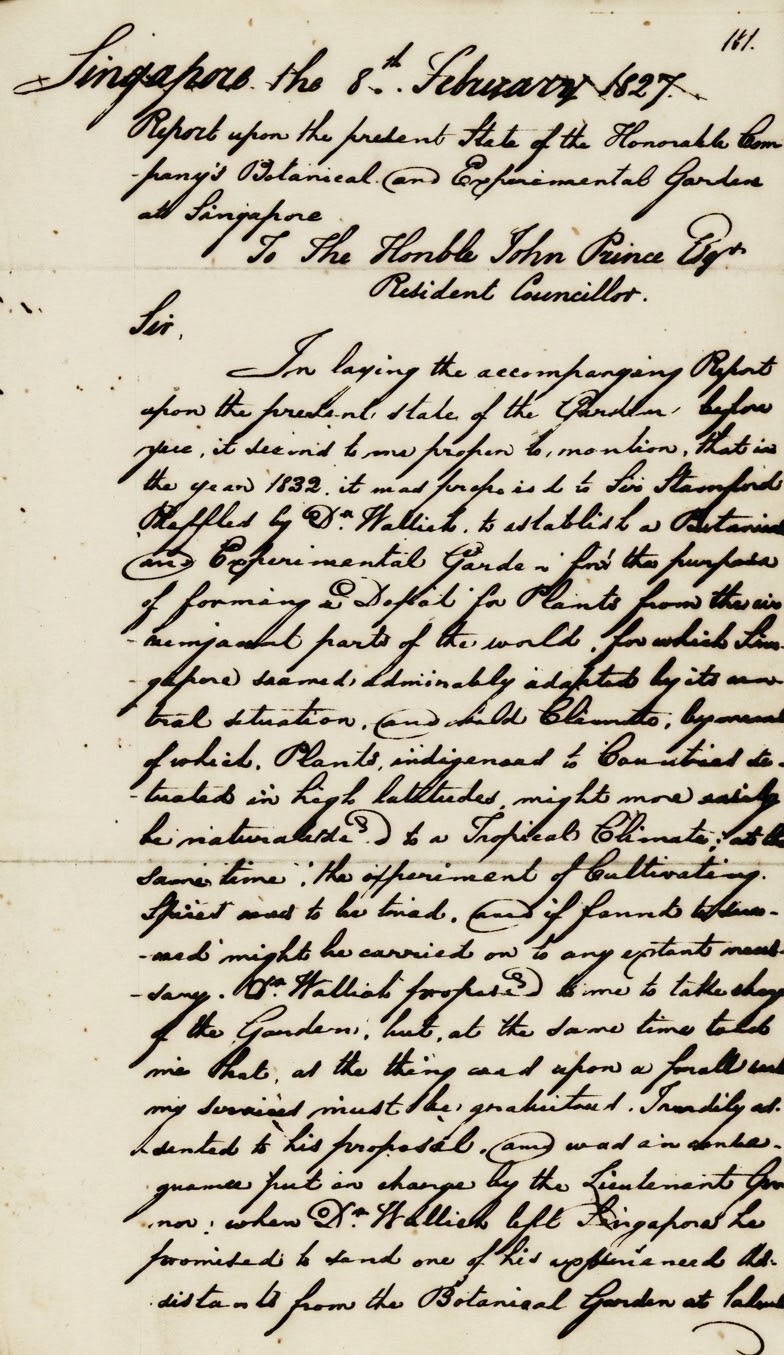
Surgeon William Montgomerie was appointed as the supervisor of the botanic garden in June 1823. With a budget of only 60 Spanish dollars and a crew of 14 labourers, including three convicts, he was able to build an impressive garden. By 1827, the garden had around 900 plants, mostly nutmeg and clove trees and seedlings. At the front of the garden, there was “a brick wall with pillars, and intervals of woodwork”, while its hill-facing side was bordered with a bamboo fence. In addition, the lower grounds of the garden were also drained to make way for roads. Montgomerie’s work is detailed in his report to the Resident Councillor of Singapore on 8 February 1827, shown above. The report can be accessed digitally via Citizen Archivist (opens in new tab) website. (Image Credit: National Archives of Singapore) (opens in new tab))
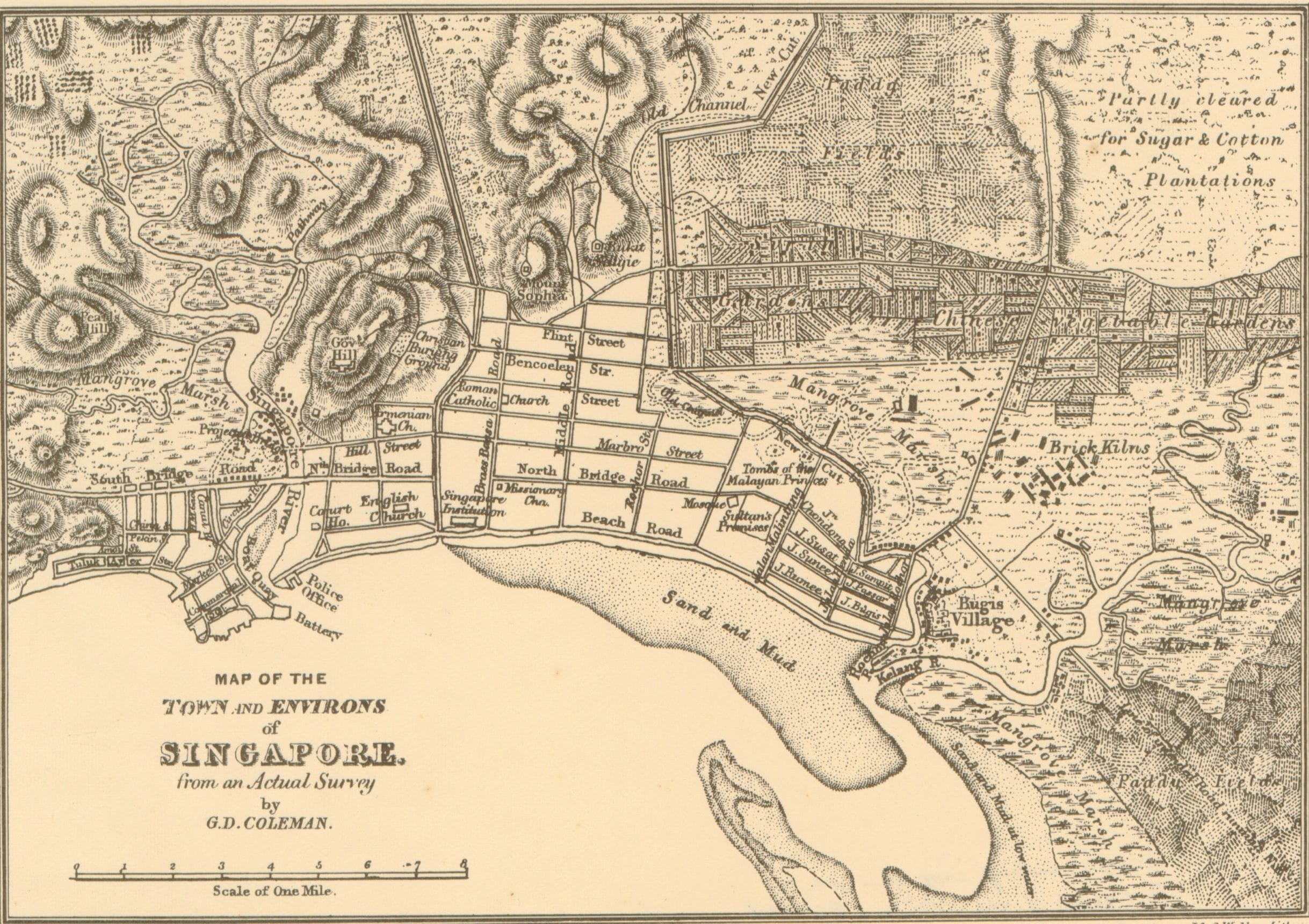
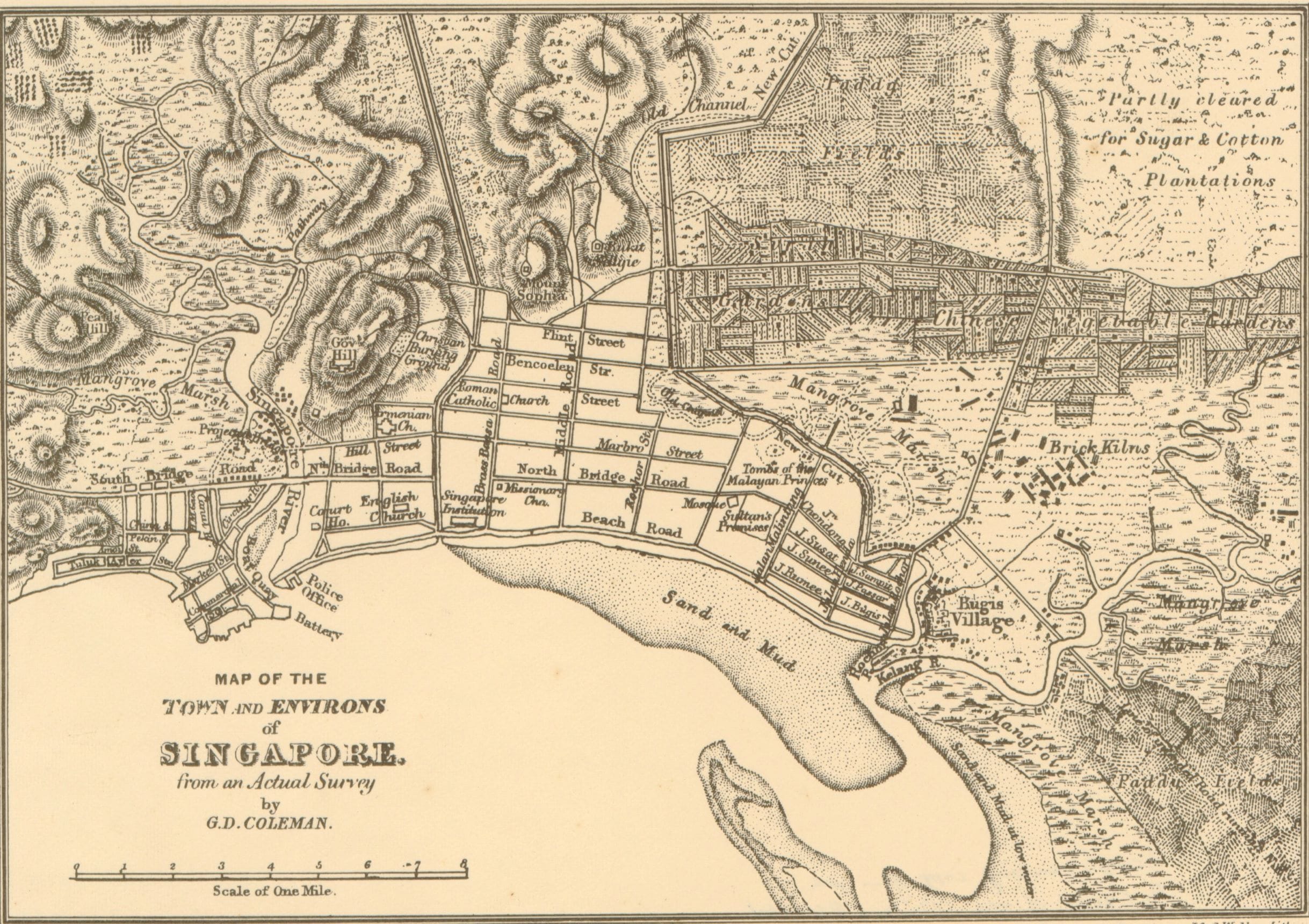
However, due to the high upkeep required, coupled with a lack of funding and government support, the garden was eventually closed in June 1829. Its land was then parcelled out for various public projects, including the Armenian Apostolic Church of St Gregory the Illuminator, as shown in the survey map of Singapore town prepared by George D. Coleman in 1839, which is displayed above. (Image Credit: National Archives of Singapore (opens in new tab))
Christian Cemetery
Besides the “Botanical and Experimental Garden”, Fort Canning Hill was also the site of one of Singapore’s earliest Christian burial grounds. The cemetery encompassed two burial sites, with the first used from 1819 to 1822 and the second from 1822 to 1865. It was closed to further burials after the completion of the Bukit Timah Christian Cemetery. Today, the former grounds of Fort Canning Cemetery (opens in new tab) is known as Fort Canning Green and is part of Fort Canning Park.
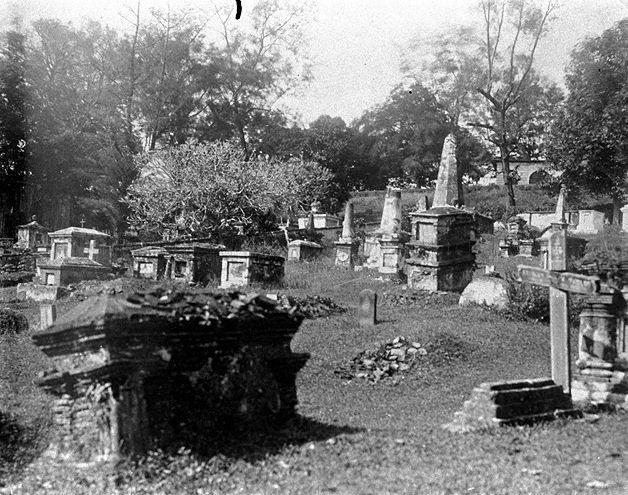
The first burial site of Fort Canning Cemetery was located near the hilltop, close to Raffles’s bungalow. At least three burials were made here: John Casamajor, a Commercial Resident of the British East India Company and judge who was visiting from India, died in Singapore on 1 February 1821; John Carnegy, a ship captain, died on 12 February 1821; and John Collingwood, a ship commander, died on 21 November 1821. However, the use of the cemetery was discontinued at the end of 1822 after it was found to be too close to Raffles’s residence. There are no visible traces of this cemetery left, unlike the second site, which is shown in this 1912 photograph. (Image Credit: National Archives of Singapore (opens in new tab))
"The oldest tomb discovered is that dated 1821, erected to the memory of John C. Collingwood of the ship "Susan". It is surmised that this stone was taken from the old original Cemetery and re-erected here, as this Cemetery was not opened until 1822. The latest discovered is dated 1868, erected to the memory of Marie Dominica Scott, a child of only two years of age, and the interment presumably took place after the Cemetery was closed in 1865, as the parents were possibly interred here."— In H. A. Stallwood's compilation published in the June 1912 issue of the Journal of the Straits Branch of the Royal Asiatic Society (Call no.: RCLOS 959.5 JMBRAS, p. 77), the above findings detail the oldest and most recent tombs among the more than 600 burials that took place at Fort Canning Cemetery between 1822 and 1865.
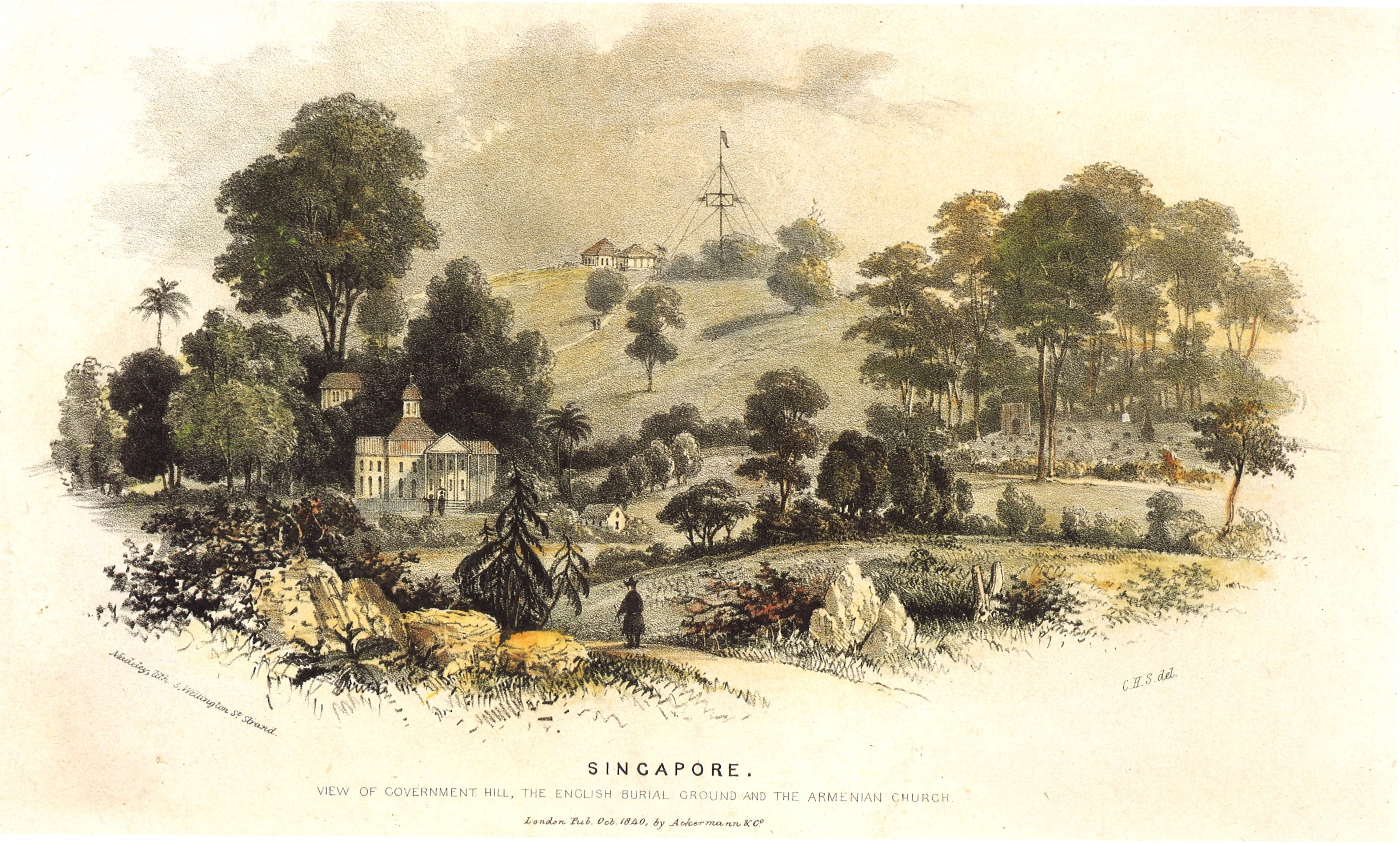
The second burial site was located on the slopes of Fort Canning Hill. This two-acre parcel of land soon became full and an application for a new burial site was made by the then resident chaplain, Reverend Robert Burn, in 1827. However, instead of a new burial site, the cemetery was extended. Due to the restricted size of the cemetery, segregation of Protestant and Catholic burials was not strictly enforced until 1845. In the same year, the cemetery was extended again to include land to the east of the central path. Then, in 1846, a brick wall and a pair of gates with a Gothic design were built to enclose the cemetery. Around the time of the wall’s construction, two arches were also built on the south (seaward) and land-facing sides of the burial ground. Shown here is an 1840 painting by Charles Hamilton Smith of Fort Canning Hill where the cemetery can be seen on the right. Titled, “View of Government Hill, the Burial Ground and the Armenian Church”, this painting is taken from Singapore Through 19th Century Prints & Paintings (1989) (Call no.: RSING 769.499595703 WON (opens in new tab)). (Image Credit: All rights reserved, Wong, Hong Sen (1999). Singapore Through 19th Century Prints & Paintings. National Museum of Singapore: Editions Didier Millet (opens in new tab))
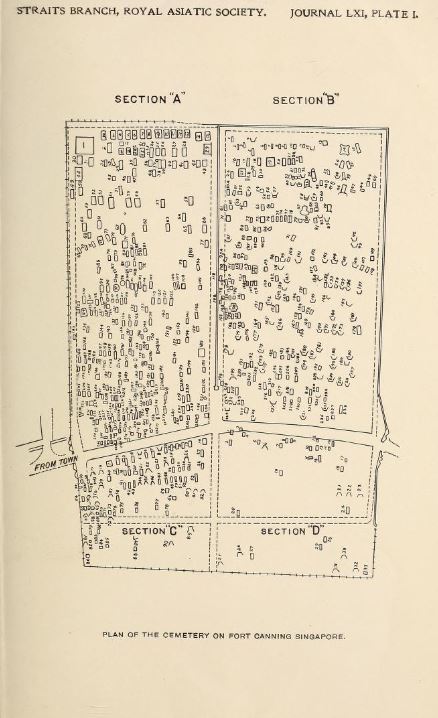
As the cemetery’s burial register had been lost, the government hired H. A. Stallwood to recompile the burial register by copying details from tombstones in the cemetery. Although he was hampered by the poor condition of some of the tombstones, as well as the haphazard and crowded layout of the cemetery, he was able to complete the assignment. His findings, along with the above plan showing the locations of all the tombs and monuments, were later published in the Journal of the Straits Branch of the Royal Asiatic Society in 1912 (Call no.: RCLOS 959.5 JMBRAS (opens in new tab); also available digitally in the Biodiversity Heritage Library (opens in new tab)). (Image Credit: All rights reserved, “The Old Cemetery on Fort Canning, Singapore”, Journal of the Malayan Branch of the Royal Asiatic Society, 1912, Stallwood, H., 61 (opens in new tab))
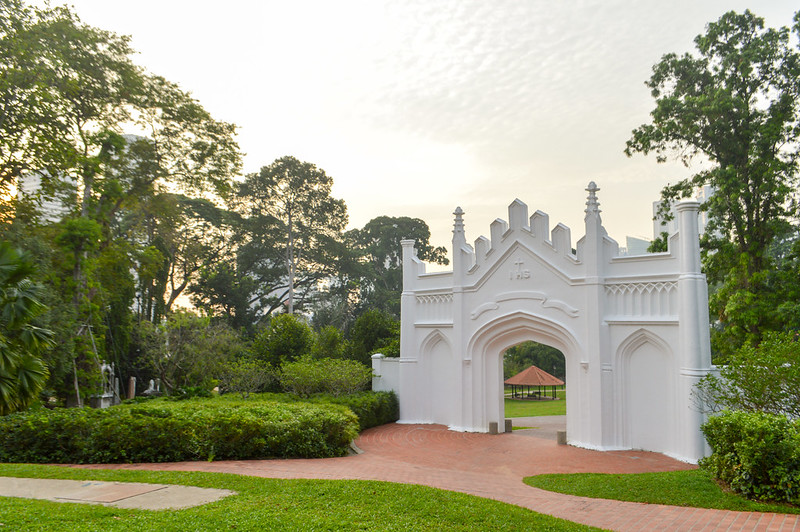
By the end of 1863, there was no more space at the cemetery once again, and a new site in Bukit Timah was identified as an alternative burial site. Between 1822 and 1865, more than 600 burials had taken place at the Fort Canning Cemetery, with around a third of these being those of Chinese Christians. Today, the old Christian cemetery has been cleared, but visitors can still find traces of it on Fort Canning Hill, including the cemetery’s two Gothic gates, the James Brooke Napier Memorial that was built in memory of William and Maria Frances Napier’s infant son, as well as two dome-shaped cupolas. The above photograph shows one of the two Gothic gates of the former cemetery. (Image Credit: Photo by Francisco Anzola via Flickr (opens in new tab))
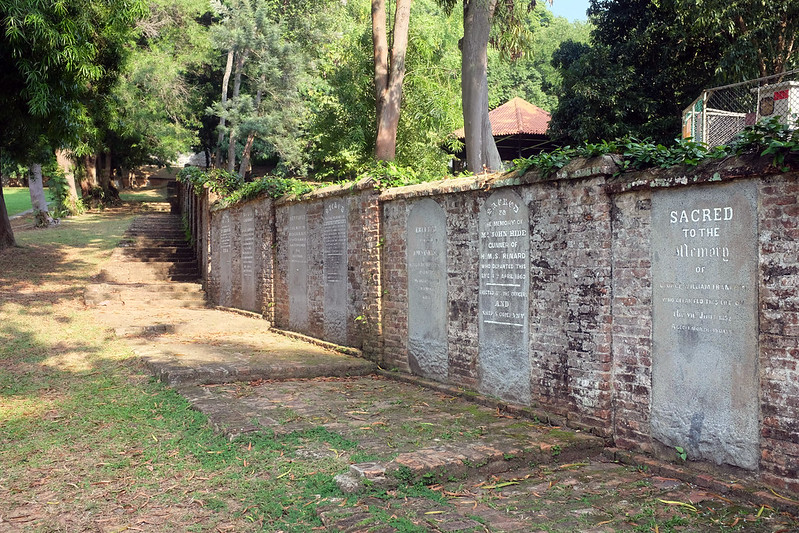
Some gravestones of the old cemetery can also be found either built into the walls of the former cemetery or in the garden compound of the Armenian Church of St Gregory the Illuminator (opens in new tab) on Hill Street. The clearing of the cemetery started in 1954 when the City Council’s Committee for the Preservation of Historic Sites and Monuments announced the plan to turn some remnants of the cemetery into a “Garden of Memory”. This continued until the early 1970s. (Image Credit: Photo by Jnzl’s Photo via Flickr (opens in new tab))
King George V Park (Today’s Jubilee Park)
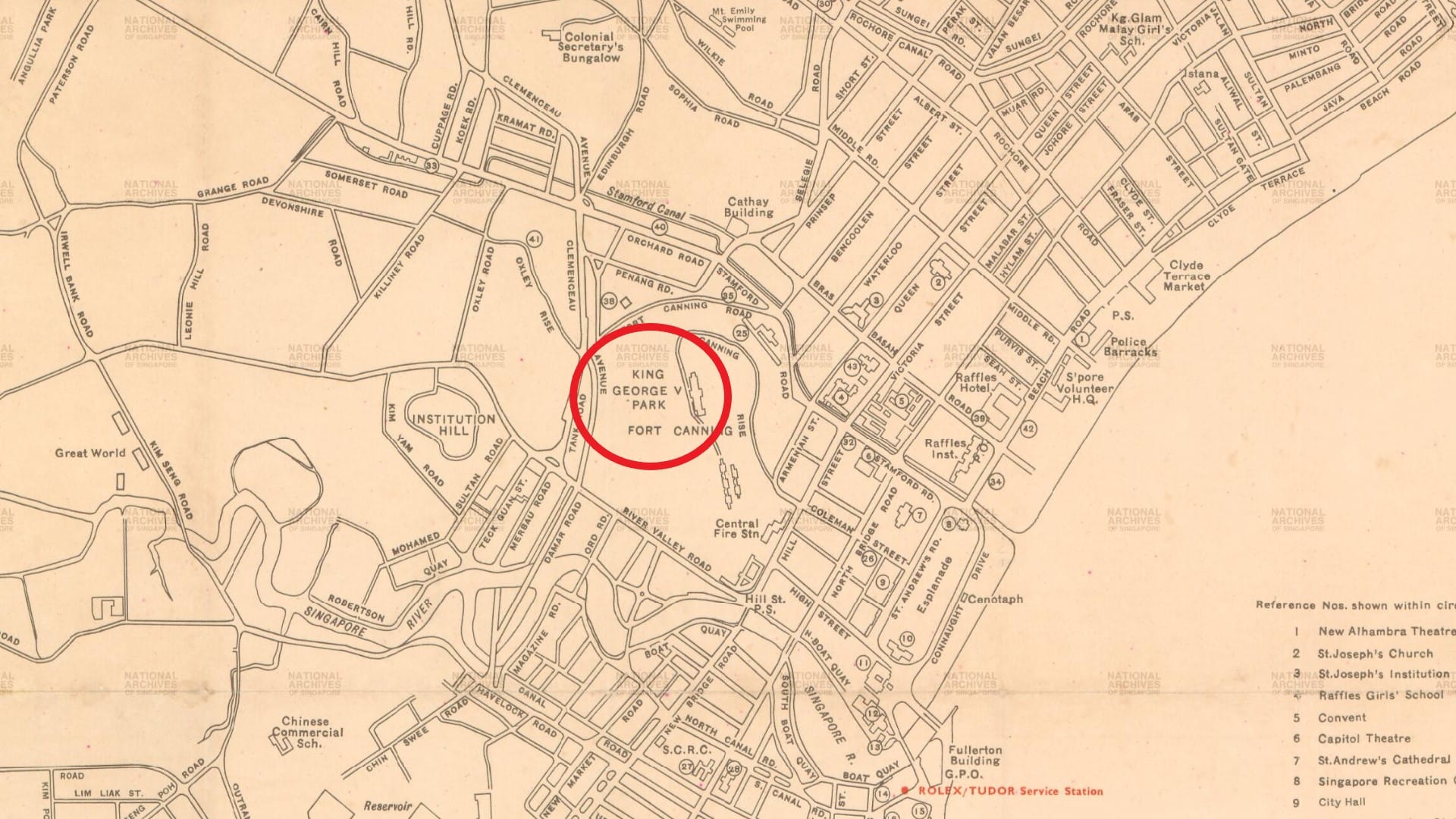
King George V Park was located southwest of Fort Canning Hill at the junction of River Valley Road and Clemenceau Avenue. It was thus named to mark the silver jubilee anniversary of King George V and Queen Mary in 1935. The park was very popular during the postwar period and was known for its lush greenery and towering trees. In 1972, it was incorporated into today’s Fort Canning Park before being revived as Jubilee Park in 2019.
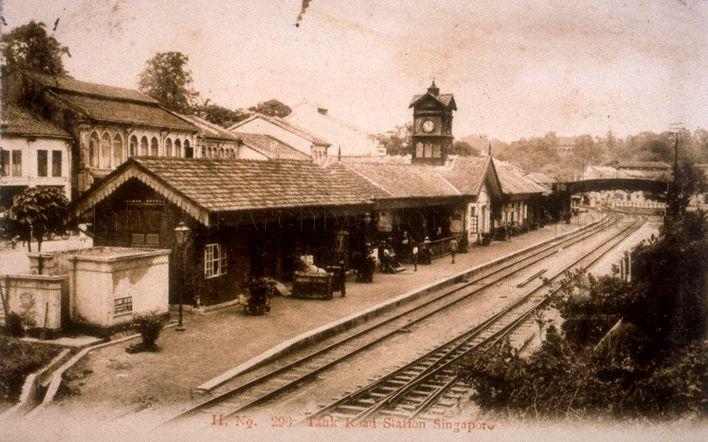
King George V Park was located at the railway yard of the former Tank Road Railway Station. Opened in 1906, it served as the terminus for passenger trains in Singapore for the Singapore Railway Line (opens in new tab) until the completion of the Tanjong Pagar Railway Station in 1932. (Image Credit: National Archives of Singapore (opens in new tab))
"The children from the slums off River Valley Road have a haven - the King George V Park bounded by Clemenceau Avenue at the foot of Fort Canning, Singapore's famous landmark. Scores of scraggy kids can be seen emerging from their rambling homes a stone's throw away, like rabbits out of their holes, to play on the green grass in the cool of the evening. It is a familiar sight to see a group of five or six boys lolling on the grass in a shady nook or playing a game of imitation Blind Man's Bluff. From 5.30 or 6 p.m. onwards every day, one can see a flow of these children into the park, from babes-in-arms to the age of adolescence. Some are accompanied by their parents. Peals of laughter rise above the din of the busy traffic and the park rings with a hundred gay young voices of children at play. The few swings and chutes that are there to delight the kiddies and young visitors are always occupied. In another corner, some wide-eyed toddler is being fed by Mama. A large number of these children, shut out from all sunlight in their rickety homes across the road, are in need of fresh air and sunshine more than food. Although it doesn't boast of being a second Hype Park, this green enclosure with its many shady trees and flowering shrubs is regarded by many as the Colony's most beautiful public garden."— In a 7 May 1948 article from The Straits Times (NewspaperSG, p. 4), the above excerpt highlights how King George V Park—once described as an "uninviting" spot—was transformed after the Second World War into "the Colony's most beautiful public garden" and impacted the lives of local residents:
King George V Park was named to mark the silver jubilee anniversary of King George V and Queen Mary in 1935. The park was very popular during the postwar period and was known for its abundant lush greenery. There were also pathways built in the park and amenities such as benches and swings. (Image Credit: National Archives of Singapore (opens in new tab))
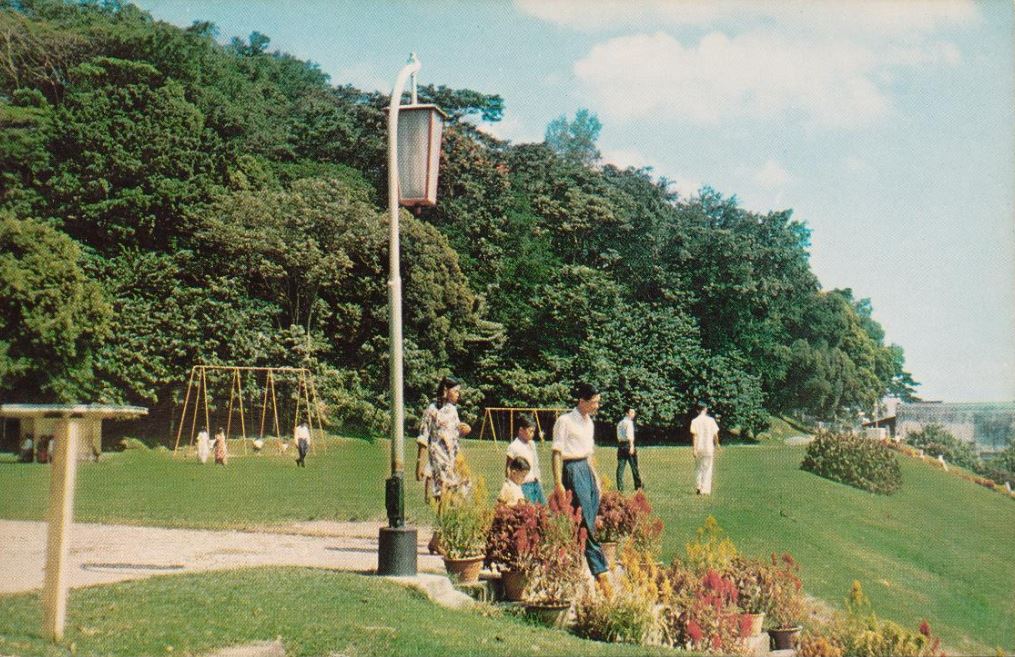
Some of the trees in the dense variegated foliage in King George V Park included Flame of the forest, Yellow flame, Bungor tree, Jacarandas, Cassias and Tembusu. They were planted when the park was built before the war. During the Japanese Occupation, the park became a Japanese military area which meant that these plantings were undisturbed and thus able to flourish. (Image Credit: Courtesy of the National Museum of Singapore, National Heritage Board (opens in new tab))
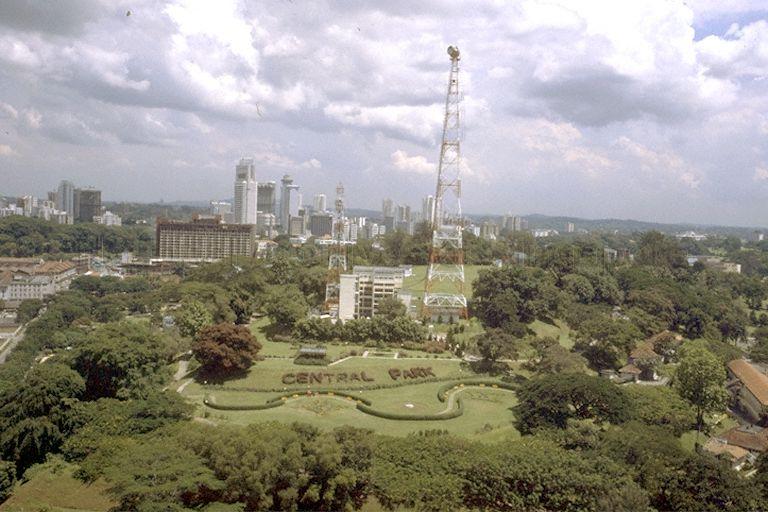
In the 1970s, King George V Park was incorporated into a larger park. Initially called Central Park before being renamed Fort Canning Park in 1981, this new 100-acre park was dubbed the “biggest ever green lung” in the city area at the time. It included King George V Park and the former grounds of the headquarters of the Malaya Command on Fort Canning Hill which by then had come under the purview of the Singapore Armed Forces. (Image Credit: Ministry of Information and the Arts Collection, Courtesy of National Archives of Singapore (opens in new tab))
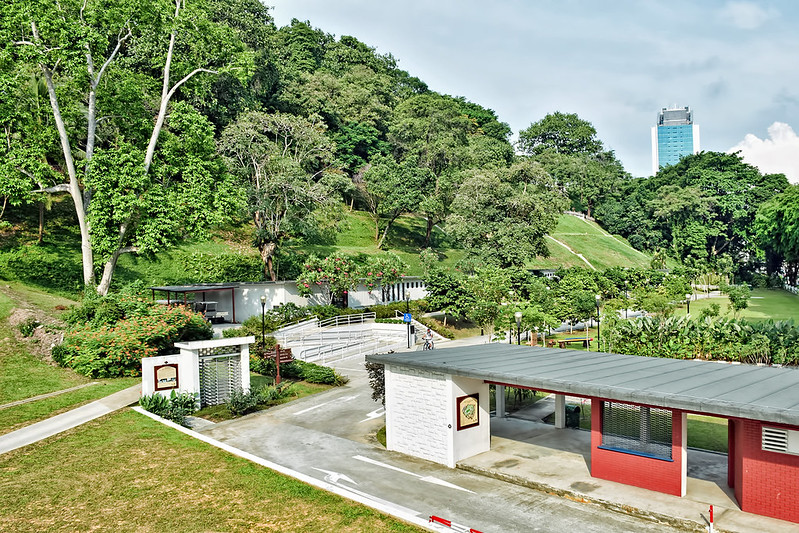
Modelled after and situated at the site of King George V Park, Jubilee Park was created within the grounds of Fort Canning Park in 2019. The park is a family-friendly leisure space, known for its giant seesaws, slides that follow their surrounding terrain and climbing frames made out of natural logs. (Image Credit: Photo by Choo Yut Shing [CC BY-NC-SA 2.0] (opens in new tab))
Former Recreational Grounds of Fort Canning Hill
King George V Park was not the only recreational ground on Fort Canning Hill. There were others, including the River Valley Swimming Complex, the Van Kleef Aquarium, and the National Theatre. Although these places are no longer around, they were very popular during the postwar period and the nation-building years.
National Theatre
The National Theatre (opens in new tab), completed in 1963, was a significant cultural venue during the nation-building years and situated in King George V Park. It hosted performances, concerts, and conferences, but was eventually demolished in 1986 due to structural concerns.
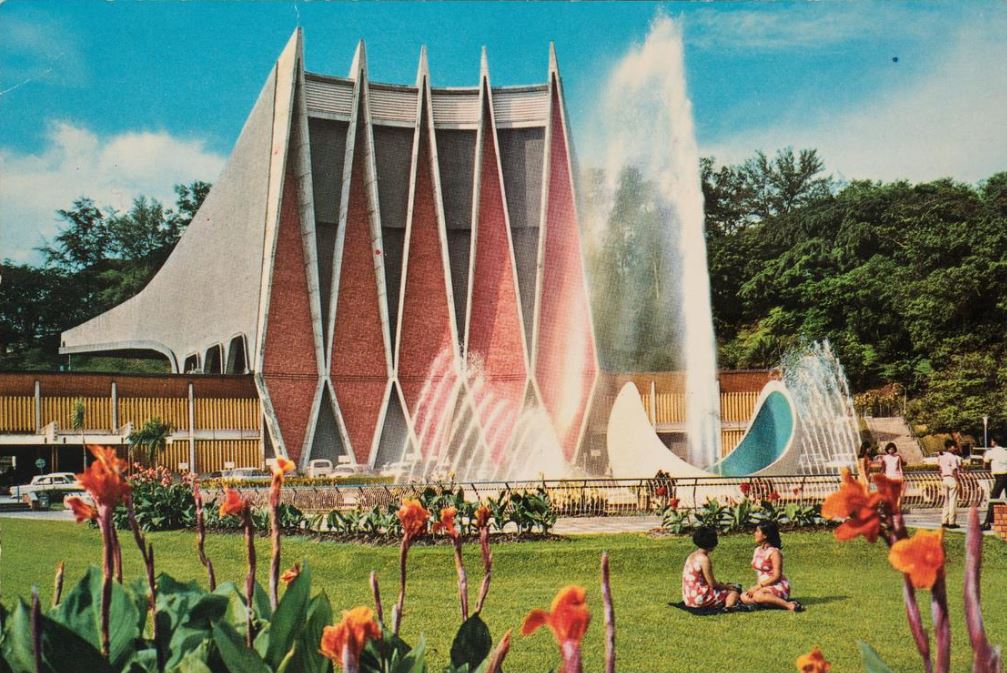
The National Theatre was known for its iconic architecture. The theatre was designed by local architect Alfred Wong and featured an open-air auditorium with a stunning 150-tonne cantilevered steel roof that extended beyond the seating area. The roof was supported by a wall with five vertical diamond-shaped bays, which formed the distinctive facade of the theatre. In 1965, a crescent-shaped fountain was added in front of the theatre’s five-diamond facade, leading many to believe that it represented the crescent moon and five stars on Singapore’s National Flag (opens in new tab). (Image Credit: Courtesy of the National Museum of Singapore, National Heritage Board (opens in new tab))
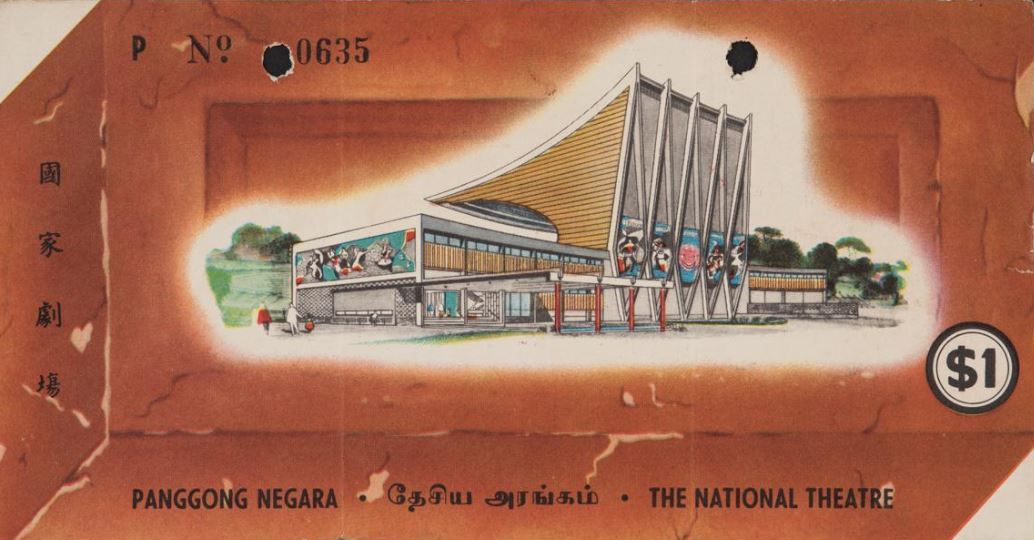
The National Theatre was built to commemorate Singapore’s achievement of self-government in 1959. It was also known as the “People’s Theatre” as members of the public had contributed towards the theatre’s building fund through various fundraising activities including the “A-Dollar-A-Brick” campaign. (Image Credit: Courtesy of the National Museum of Singapore, National Heritage Board (opens in new tab))
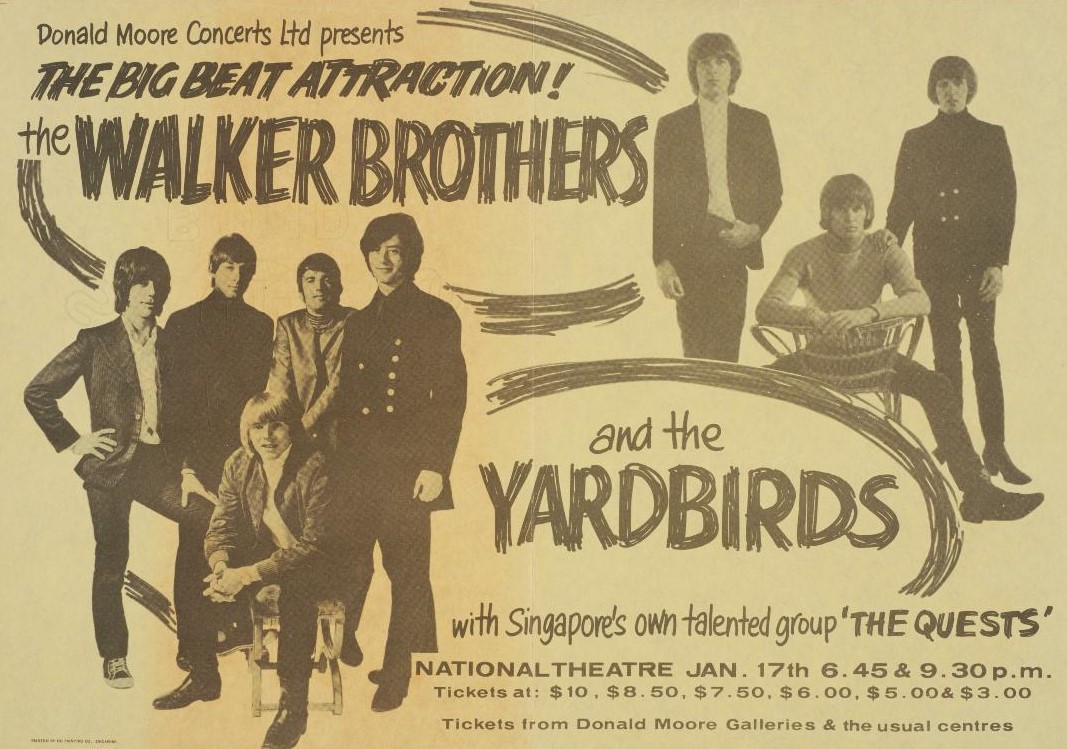
During its years of operation between 1963 and 1986, the National Theatre was the venue of many important events including the annual National Day rallies from 1966 to 1982. It was also used for performances and concerts featuring famous artists and performing groups such as the Louis Armstrong Jazz Band, the Duke Ellington Orchestra, the NHK Symphony Orchestra, the Bee Gees, the Walker Brothers, and the Yardbirds. Shown above is a handbill promoting a Walker Brothers and the Yardbirds performance at the National Theatre in January 1967. (Image Credit: Courtesy of the National Museum of Singapore, National Heritage Board (opens in new tab))
Van Kleef Aquarium
Van Kleef Aquarium (opens in new tab) was Singapore’s first public aquarium. Located at the foot of Fort Canning Hill, the aquarium was opened in 1955. It quickly became a popular attraction for both locals and tourists. Over the years, the aquarium underwent several renovations and upgrades, but it was ultimately closed in 1996, and the building was demolished in 1998. Despite its closure, the aquarium is still remembered fondly by many Singaporeans as an important part of the country’s history and heritage.
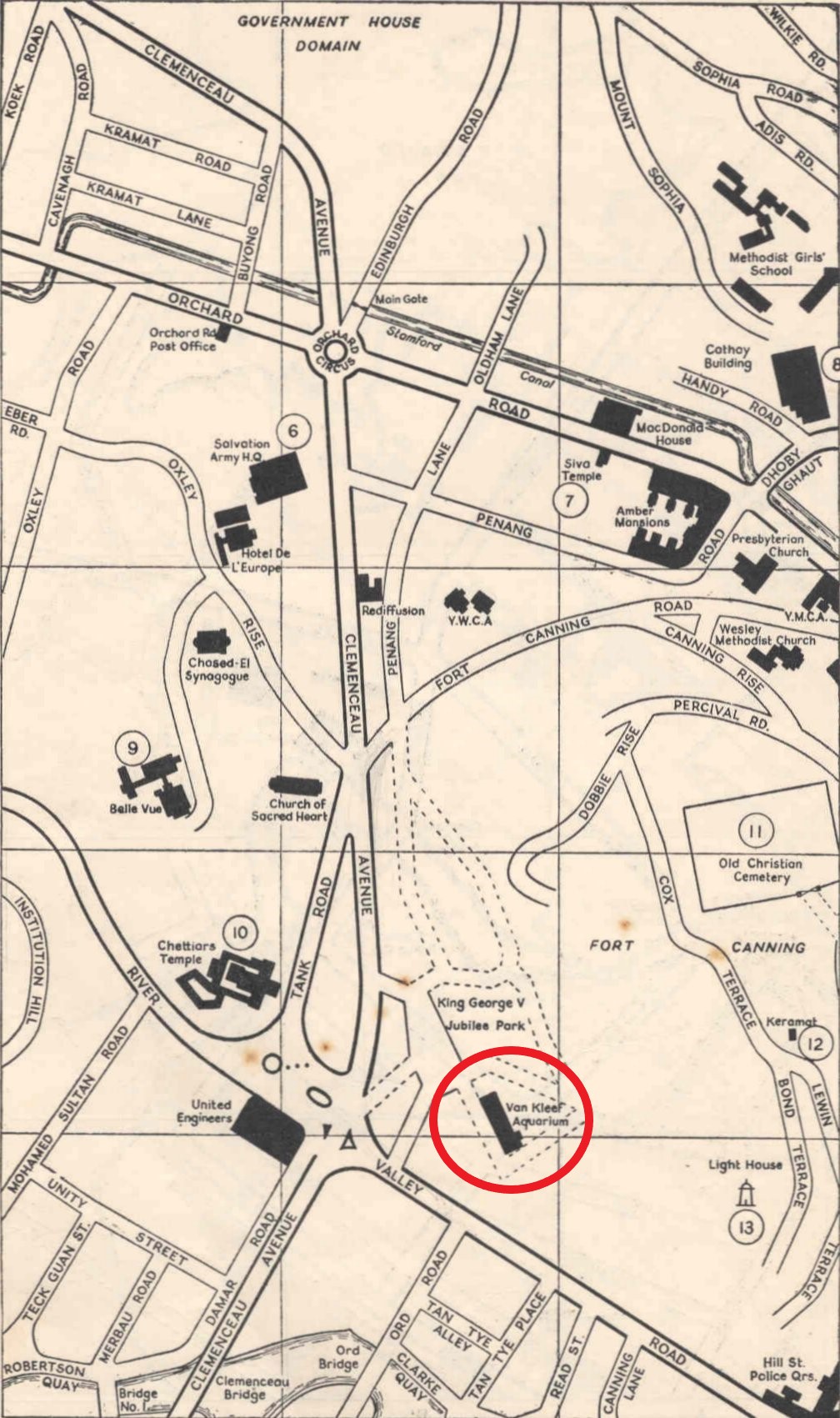
Van Kleef Aquarium was named after a Dutch businessman in Singapore. When he died in 1930, he bequeathed the net proceeds of his estates, valued at around $160,000, to the municipal government for the “embellishment of the town”. After much discussion and delay, the municipal government decided to build an aquarium on the western slopes of Fort Canning Hill between Tank Road and River Valley (opens in new tab) Road beside King George V Park. (Image Credit: Singapore Land Authority (opens in new tab))
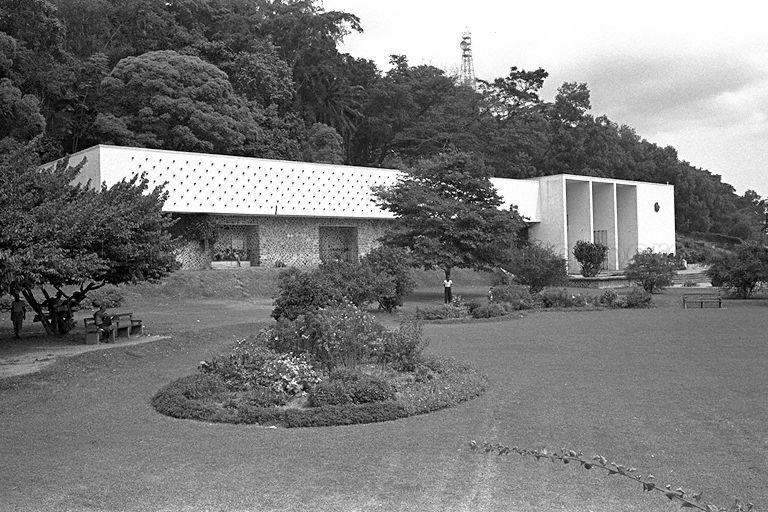
Construction of the aquarium begun in 1940 but was derailed by the Japanese Occupation of Singapore (1942–1945) and subsequent postwar reconstruction works. It was eventually completed in September 1955 after works restarted in 1953. It is worth noting that during the 1950s, the Van Kleef Aquarium was one of the most modern and well-equipped public aquariums in the world. It was also the first aquarium in Southeast Asia to be air-conditioned. The aquarium featured a wide variety of marine life, including many species that were indigenous to the region. In addition to the fish, the aquarium also had displays of coral, shells, and other marine life. Admission to the aquarium was 30 cents for adults and 20 cents for children. (Image Credit: Ministry of Information and the Arts Collection, Courtesy of National Archives of Singapore (opens in new tab))
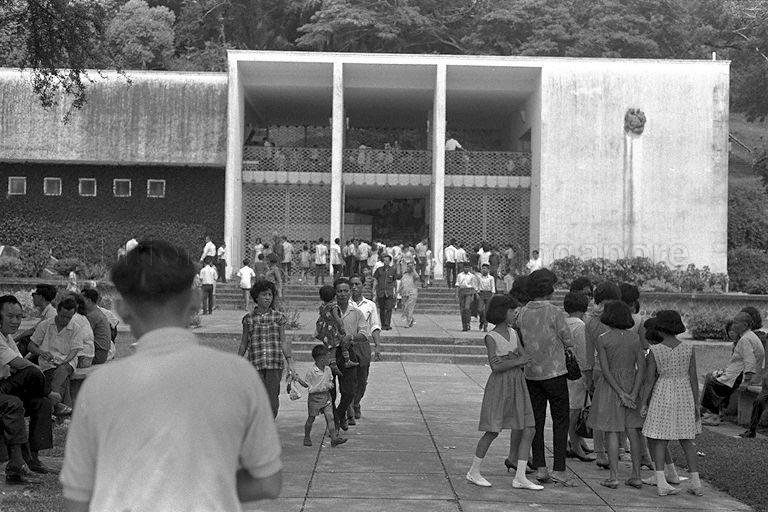
The aquarium was a success from the start. Within the first three months of its opening, 150,000 people had visited the attraction. The aquarium was also visited by prominent foreign leaders including the Madam Zhou Lin, the wife of then Vice Premier of China Deng Xiaoping, in 1978. (Image Credit: Ministry of Information and the Arts Collection, Courtesy of National Archives of Singapore (opens in new tab))
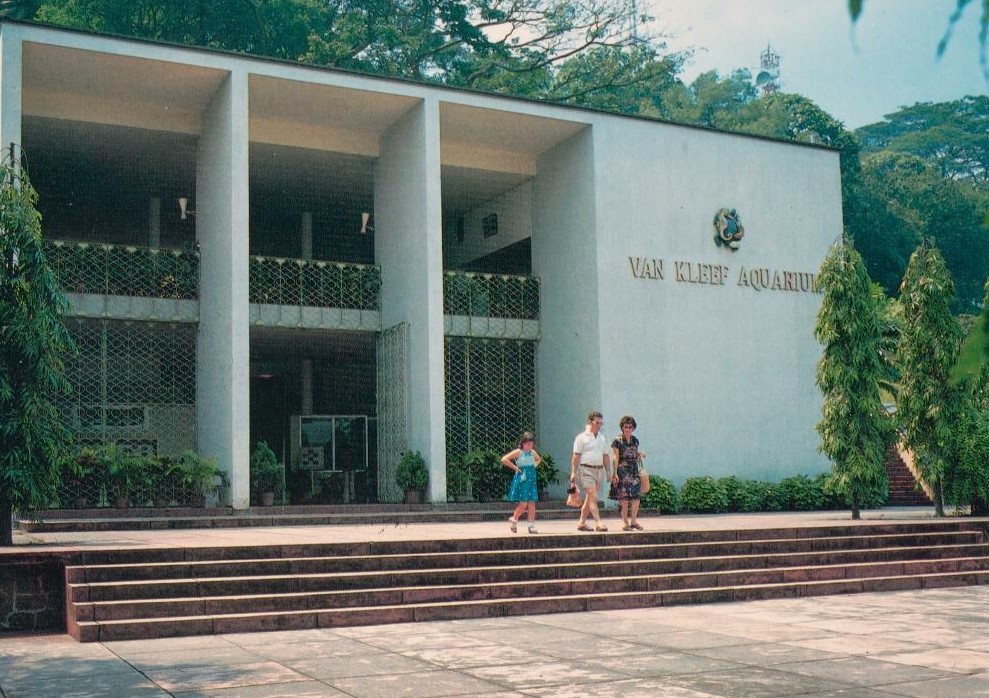
However, the popularity of the Van Kleef Aquarium began to decline following the opening of new attractions such as Singapore Zoo (opens in new tab), Jurong Bird Park (opens in new tab) and Underwater World (opens in new tab). In May 1991, the aquarium closed its doors. It then was reopened as World of Aquarium and Fort Canning Aquarium in October 1991 and 1993 respectively after changing ownership. But both endeavours were short-lived, and the aquarium closed its doors for the final time in 1996. The building was then demolished in 1998. The photograph above shows the aquarium in the 1980s. (Image Credit: Courtesy of the National Museum of Singapore, National Heritage Board (opens in new tab))
Swimming Pools
Fort Canning Hill was once the site of two swimming pools, the Young Men’s Christian Association (YMCA) swimming pool and the River Valley Swimming Complex. The YMCA pool opened in 1919, and the River Valley Swimming Complex opened in 1956. Both pools were very popular, as recreational spaces were limited at the time.
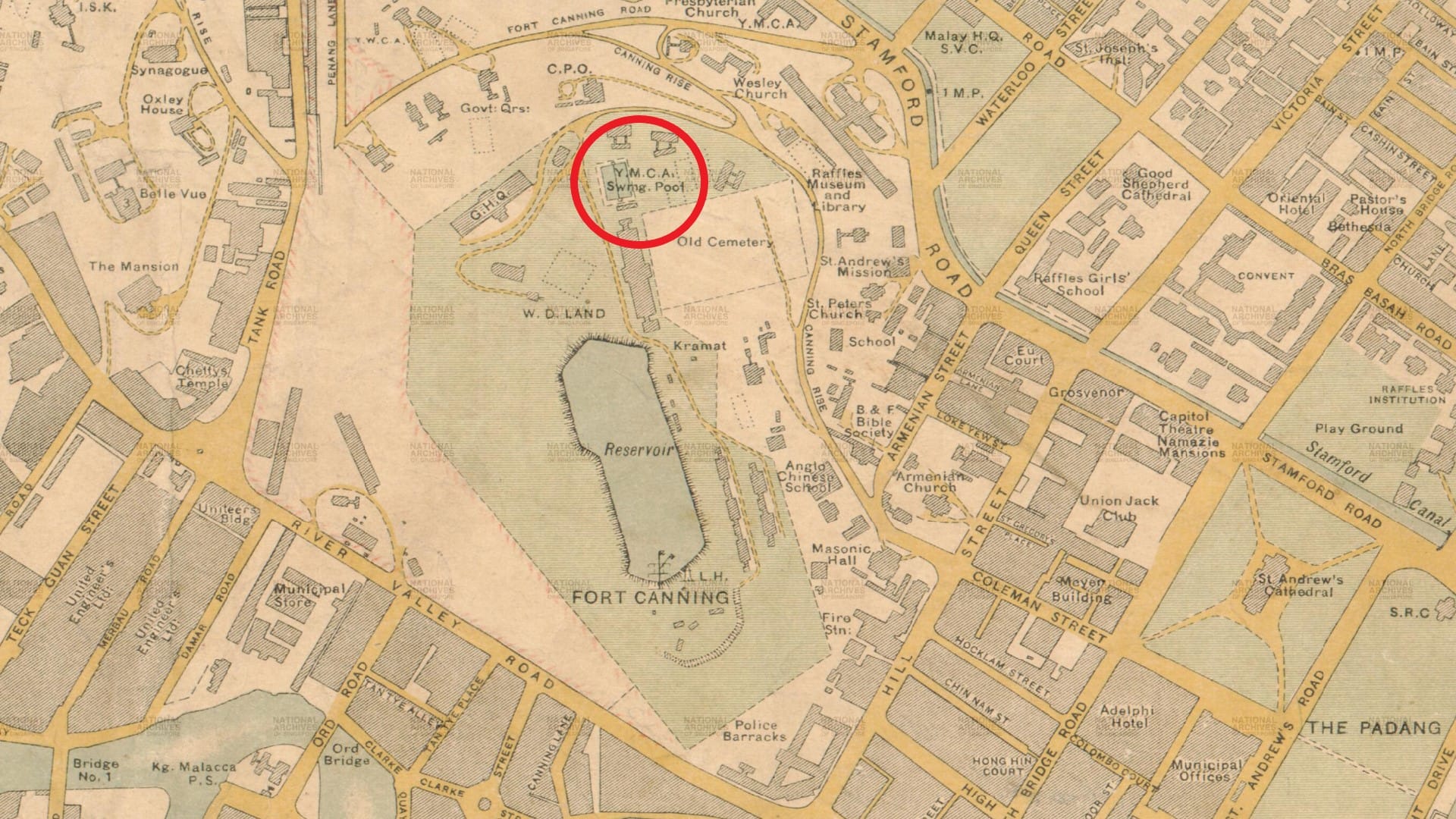
The YMCA swimming pool on Fort Canning Hill was located off Fort Canning Rise near today’s Fort Canning Centre. Originally a saltwater tank, it was opened in 1919 and measured 36 metres long (opens in new tab). The pool included a springboard, a diving stage, a freshwater bath, and dressing sheds. (Image Credit: National Archives of Singapore (opens in new tab))
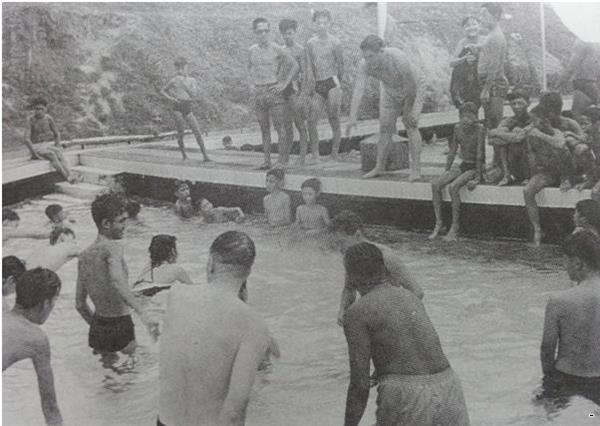
Before the swimming pool ceased operations due to the outbreak of war in 1941, it was regularly used by YMCA to conduct swimming lessons for its members. It was also the venue for swimming events such as the annual Swimming Carnival. Started in 1920, the event was a swim meet for clubs and schools in Singapore. (Image Credit: Singapore Memory Project, Photo Courtesy of YMCA of Singapore)
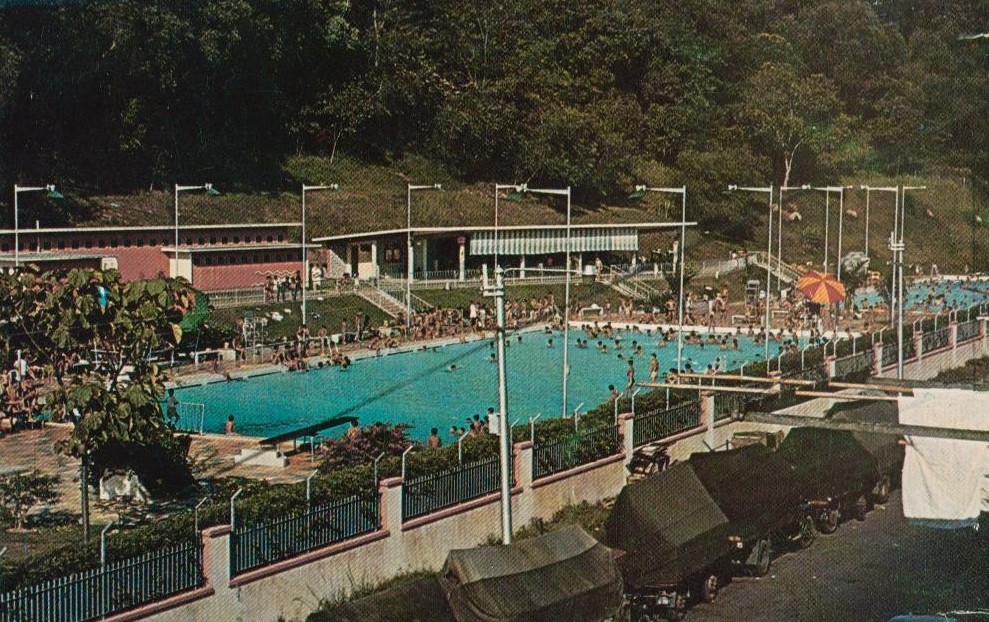
The River Valley Swimming Complex was the other swimming pool once located on Fort Canning Hill. Situated between Van Kleef Aquarium and King George V Park, it was built by the Singapore City Council to provide a recreational outlet for residents staying in the Chinatown area. The pool cost a whopping half a million dollars and was considered a “sister” pool (opens in new tab) to Farrer Park Swimming Pool. Like the latter, it had two pools, one for advanced swimmers and another for children and beginners, as well as a diving stage. (Image Credit: Courtesy of the National Museum of Singapore, National Heritage Board (opens in new tab))
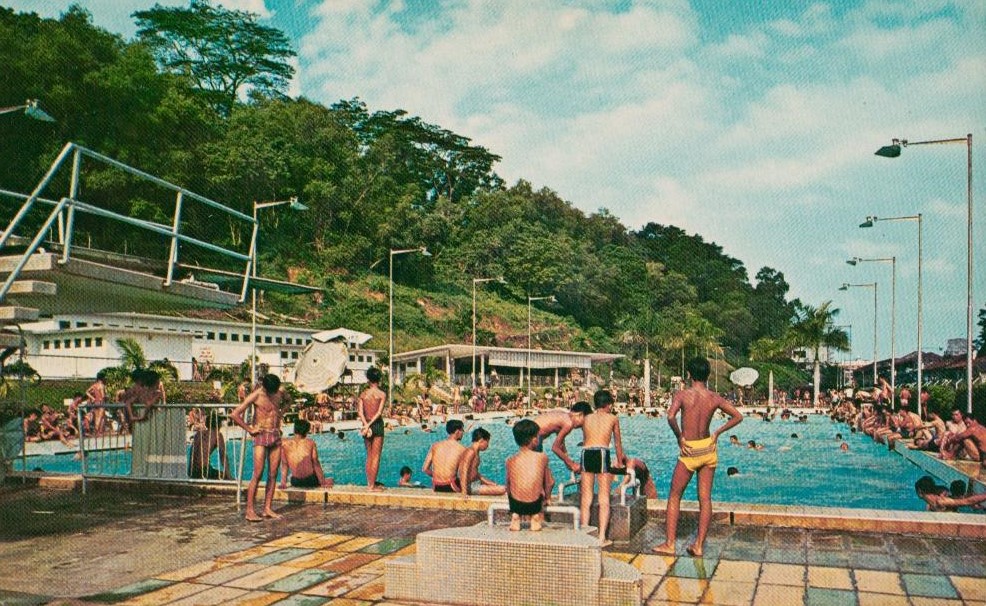
The River Valley Swimming Complex started operations in 1959 and was very popular. It was used to hold many swimming events and activities, including YMCA’s swimming lessons for children and Pesta Sukan water events. However, from the 1970s, visitorship at the swimming complex began to decline as residents moved away from the city area. It was eventually closed in 2003 and the pool has since been turfed over. Today, the area is an event and lifestyle space known as ‘The Foothills@Fort Canning Park’. (Image Credit: Courtesy of the National Museum of Singapore, National Heritage Board (opens in new tab))
The Forbidden Spring and Fort Canning Service Reservoir
Swimming pools were not only the bodies of water found on Fort Canning Hill. When the British arrived in 1819, they built aqueducts to bring water down from the hill, dug wells around it and even built a service reservoir on its summit. It was also said that during ancient times, there used to be a “forbidden” spring in the hill.
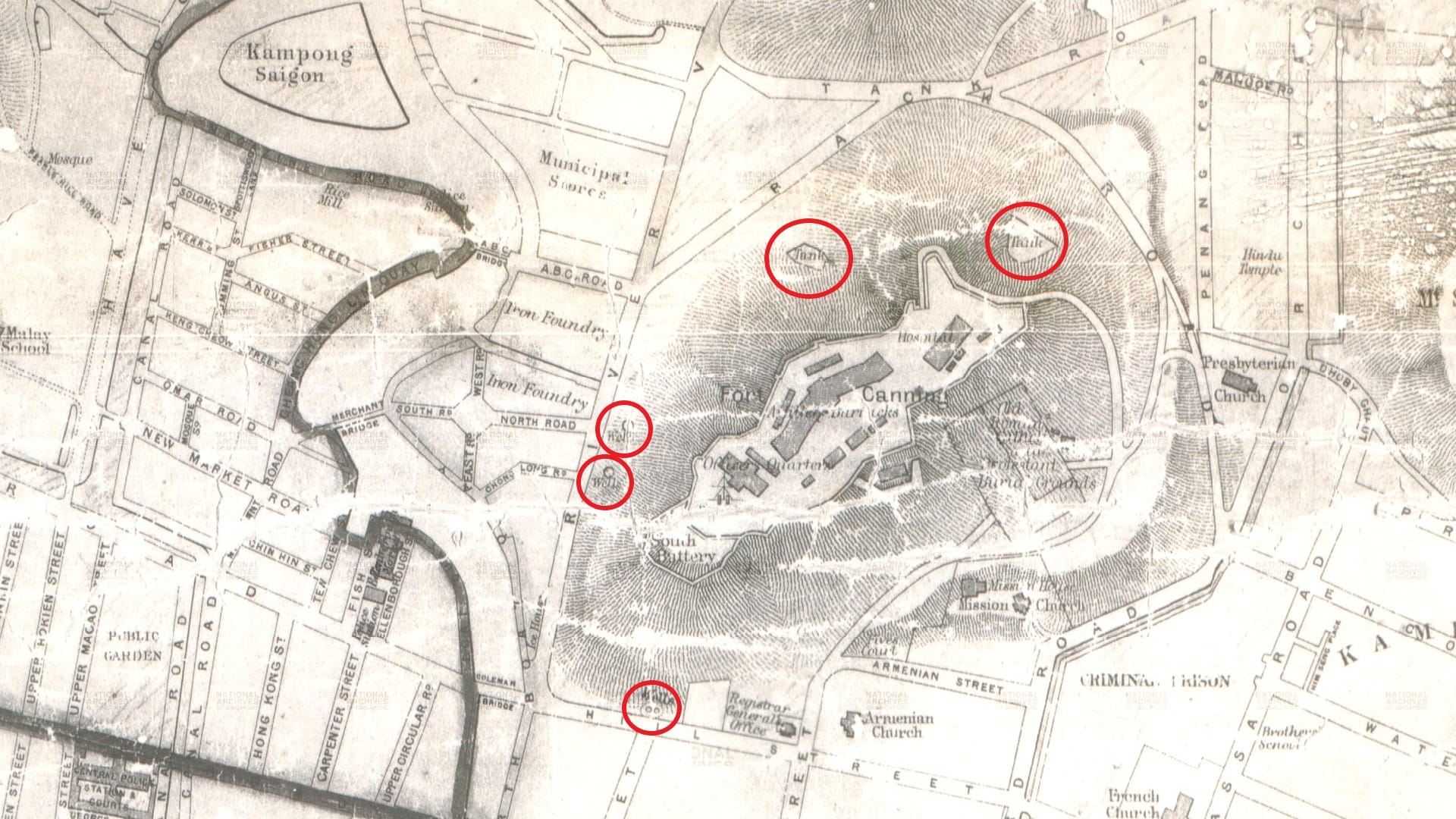
When the British arrived, they were informed of the existence of the forbidden spring. Although they did not find any remains of the ancient spring, they were able to locate a spring in the hill. To bring the spring water down to the river bank for visiting ships, the British built an aqueduct. When the spring dried up, they dug wells and built water tanks around the hill. By the late 1870s, as shown in this 1878 map, there were at least three wells and two water tanks in the foothills. The presence of the water tanks was said to have led to the naming of Tank Road. (Image Credit: National Archives of Singapore (opens in new tab))
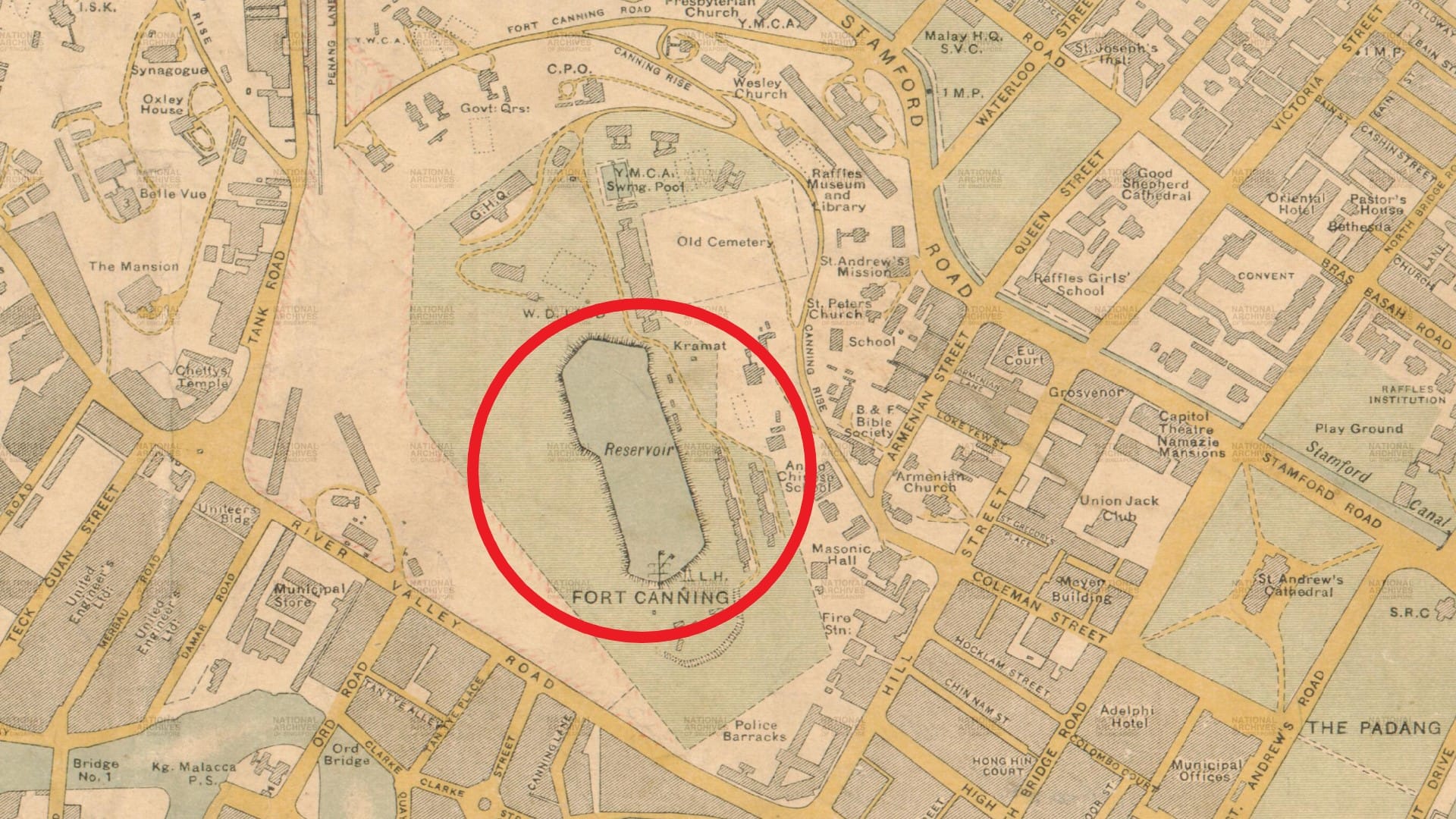
After Fort Canning was decommissioned in 1907, the British decided to replace it with a service reservoir. Completed in 1929, it was built on the site of the former artillery barracks and parade ground at Fort Canning. The reservoir extended Singapore’s water supply reserve at that time from half a day to two days. (Image Credit: National Archives of Singapore) (opens in new tab))
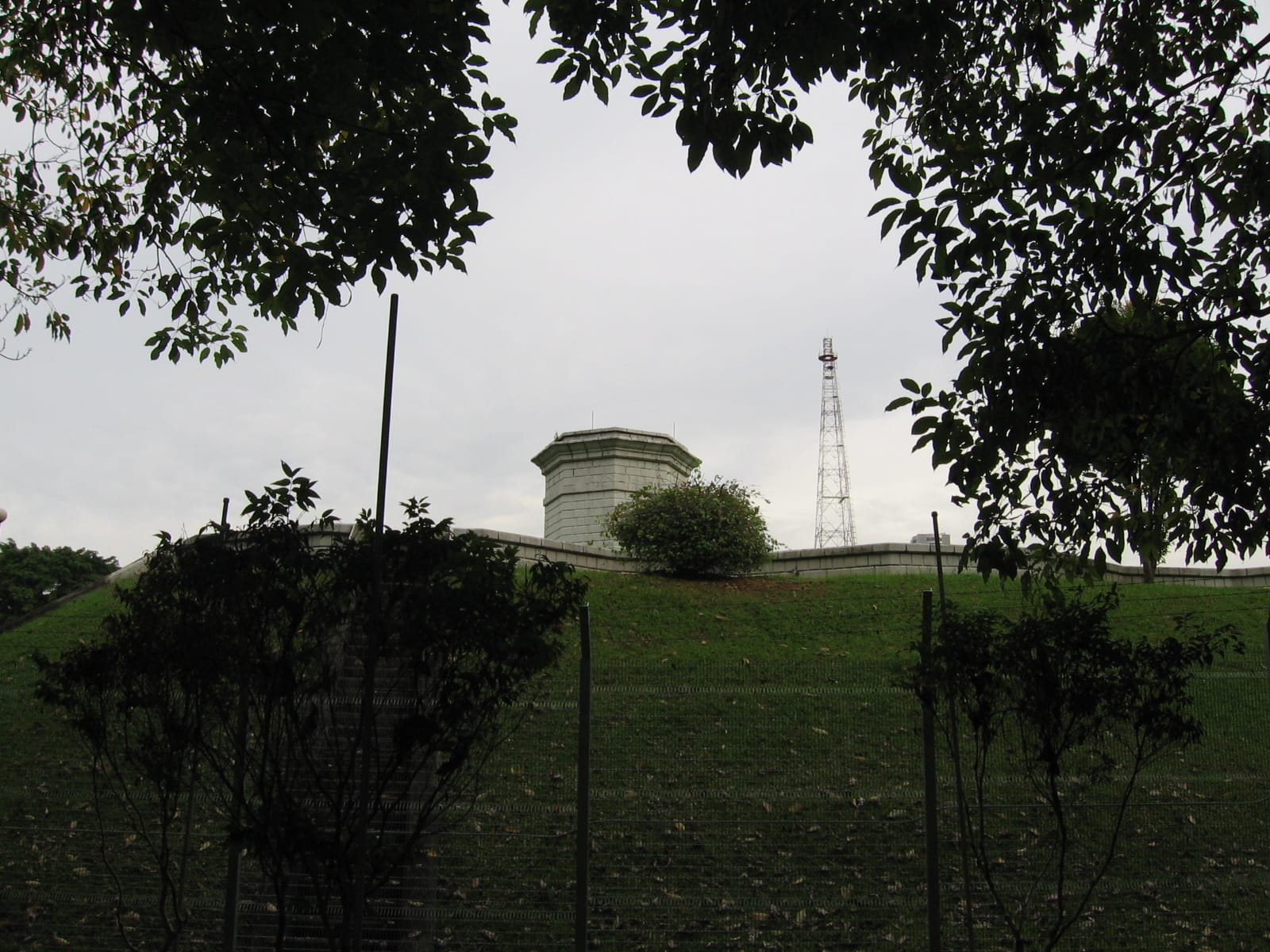
Fort Canning Service Reservoir, while presently inaccessible to the public, continues to deliver water to the city area today. As a service reservoir, it is different from other catchment reservoirs like MacRitchie and Marina. Instead of collecting water, it stores treated water that is ready to drink. Fort Canning Service Reservoir stores its water underground in two tanks. Spanning an area of over seven acres, the tanks are supported by 264 enormous hexagonal domes laid side by side. (Image Credit: Photo by Sengkang via Wikicommons (opens in new tab))
Diving into Fort Canning Service Reservoir
If you would like to find out more about this near century-old service reservoir, watch this video to see how it has stood the test of time.

Explore the Recreational and Green Spaces of the 1950s
Geo-tagged on the map below are the locations of the various recreational and green spaces on and around the hill. Click on the map below to find out more about them.
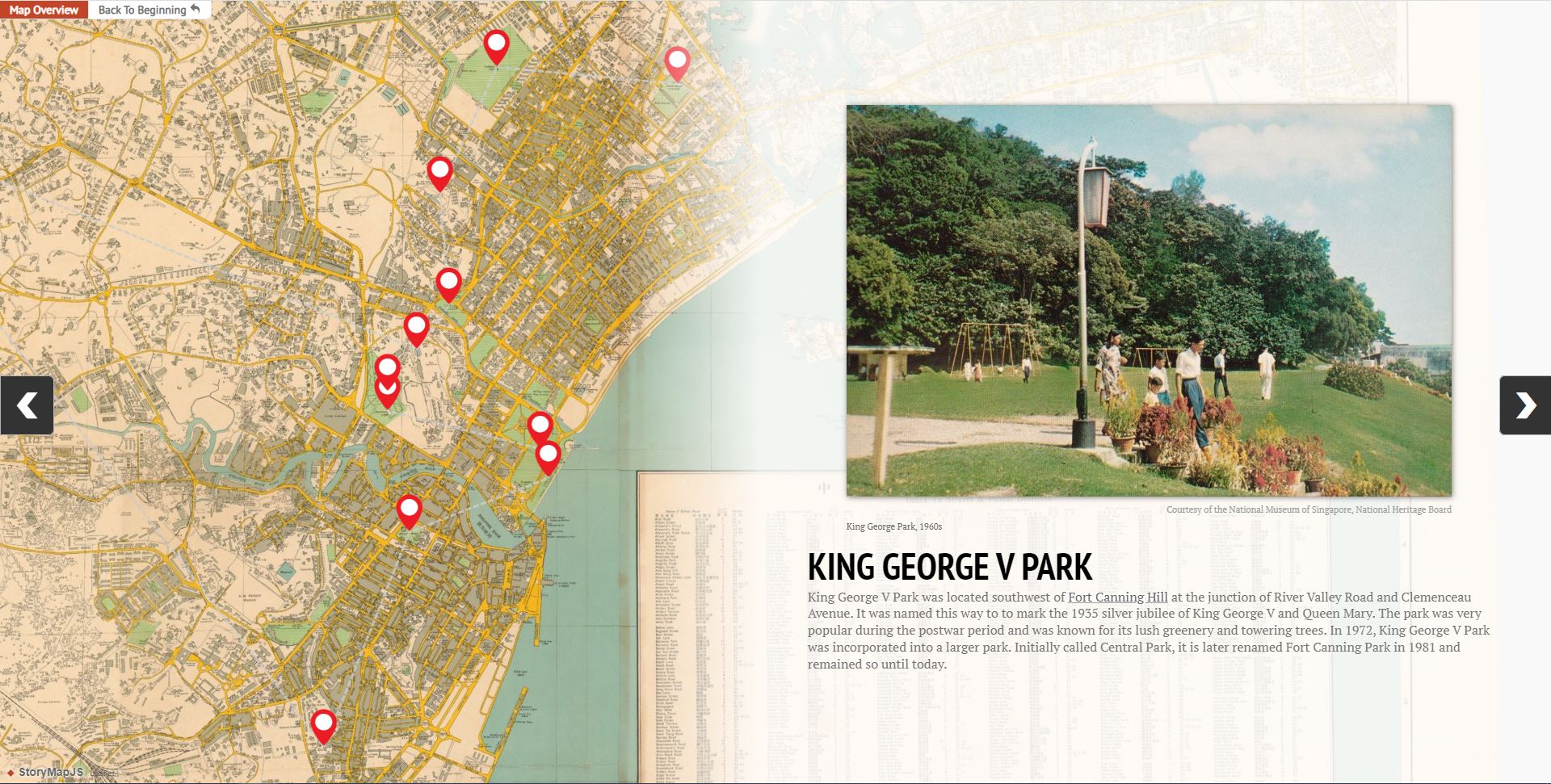
Click HERE (opens in new tab) to view the story map